







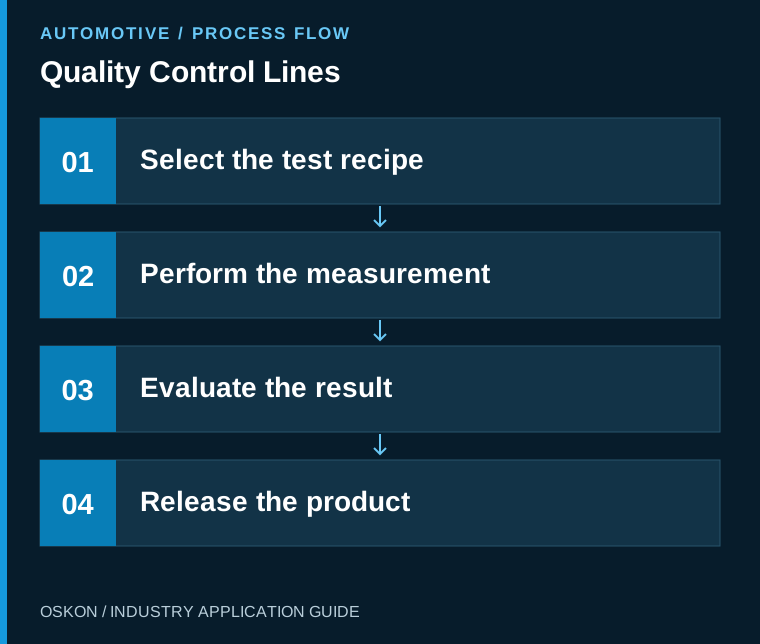
Manage test recipes, measurement results and product release decisions within a single traceable record on automotive quality control lines. Running a test does not mean the product meets every acceptance condition.
Product requirements determine the test scope
End-of-line quality control is planned around the vehicle or subassembly characteristics that require verification. Do not assume every plant uses the same tests. Prepare the control plan together with the product family, quality requirements and production process. State clearly which characteristic each test verifies.
The right test program for each product
Product identity, model and equipment configuration are linked to the test program. If the operator must select a program manually, design suitable verification to guard against an incorrect choice. Store the program revision and limit set with the result. A result reviewed later can then be assessed against the conditions at the time of testing, without mistakenly applying today's limits.
Maintain measurement reliability
The calibration status of the measuring device, the conditions of the fixture used, and the measurement method are all factors that affect the reliability of the results. The fact that a device transmits data does not in itself prove that the measurement is valid. Out-of-range measurements, sensor errors, and incomplete tests should be considered as separate situations. In repeated tests, it is the quality control team that determines which results should be used and how previous data should be preserved.
A clear workflow for failed tests
Routing nonconforming products, fault investigation, repair and retesting form a connected workflow. A retest must not erase the previous failed result. Where an authorised exception is granted, retain the reason and the decision-maker's identity. The operator interface must clearly distinguish technical communication faults from actual product nonconformity; this can help reduce unnecessary rework.

Base release conditions on all test results
The successful result of a single test station does not mean that all necessary controls for the product have been completed. The release mechanism takes into account both mandatory tests and outstanding tasks, as well as the quality status of the product. The absence of data is not the same as a failed test, but in both cases, a definitive decision must be made. The summary sent to the higher-level system must provide access to the detailed test records.
Include fault samples in acceptance testing
It is equally important to test the detection capabilities using controlled error examples as it is to perform tests with the appropriate product. Scenarios such as incorrect programs, connection interruptions, incomplete results, and retesting are tested. The adequacy of the measurement system is evaluated using the relevant quality methods. Storing the results in association with the correct product identity and being able to retrieve them from the archive are also essential requirements for the technical acceptance of the line.
Key information to monitor in the automation system
| Control point | Monitored information |
|---|---|
| Test revision | Program and limit set version |
| Measurement status | Distinguishing valid results, equipment faults and incomplete tests |
| Product disposition | The combined result of all mandatory checks |
Three questions to ask at the start of the project
- Is the test limit version stored with the result?
- Does retesting preserve the previous record?
- Is release prevented when tests are incomplete?
Explore related applications
Explore related processes in Buffer Areas and Automatic Carriers and Telescopic Bars. Browse all Automotive articles or visit Automotive solutions.