





The selection of communication and security cables is not merely about determining the number of conductors and their outer diameter. The type of signal to be transmitted, the length of the line, the configuration (twisted pair or star quad), the need for shielding, the application environment (indoor or outdoor), the method of installation, and fire resistance requirements must all be taken into account for the same product code. Birtaş Kablo’s current official product category page lists alarm cables, indoor and outdoor telephone cables, as well as halogen-free communication and fire alarm system cables. This guide serves as a selection catalog that helps users identify the correct product family without mistakenly using different category names, and it also provides explanations for the data that needs to be verified in the technical specifications.
Explore the range by installation location
The official product portfolio includes the standard and FR versions of J-Y(St)Y…Lg / Alarm and J-Y(St)Y…Lg / Communication families; PDV and PDV-K; PD-PAP; PD-AP / A; HBH and HBH-K; HBAPH and HBAPH-K; as well as PDH and PDH-K; and J-H(St)H Bd… / Communication and J-H(St)H Bd… / Fire families. However, this list does not imply that all these products can be used in the same environment or under the same electrical conditions. For example, while PD-PAP is designed for use in underground channels that are not continuously submerged in water, PD-AP / A is intended for overhead cable distribution systems with suspension wires. The alarm and communication types within the J-Y and J-H families that are discussed on the official pages are specified for indoor use only; it is clearly stated that they are not to be used outdoors or directly underground.
Therefore, it is the safest approach to start with the area containing the wiring system before making any selections. The telephone distribution system inside a building, the fire alarm circuit, the customer lines in the field, and the overhead lines between poles each operate under different mechanical and environmental conditions. Next, factors such as conductor diameter, number of pairs, type of shielding, sheath composition, and fire resistance characteristics need to be compared. The presence of designations like “FR”, “H”, “(St)”, or “K” next to a product name carries technical significance; however, the exact meaning of these codes should be determined by referring to the official product page, which provides details on the cable’s construction and technical specifications.
| Project requirement | Current families to consider | Decision point |
|---|---|---|
| Indoor fire alarm system and low-level signal transmission. | J-Y(St)Y…Lg / Alarm; J-H(St)H Bd… / Fire | PVC or HFFR material composition, pair count, conductor diameter, shielding layer, and project-specific fire protection requirements. |
| Intra-building telephone and subscriber distribution | PDV / PDV-K, HBH / HBH-K, PDH / PDH-K | Pair or star-quad arrangement, bare or tinned conductor, and sheath compound |
| Shielded indoor telephone line | HBAPH / HBAPH-K and FR options | External noise environment, screen termination, HFFR, or other configurations. |
| Telephone and protection circuits in the underground tunnel | PD-PAP | To ensure the channel does not remain underwater, as well as considering the diameter of the conductor and the route conditions. |
| Overhead distribution of customer lines between poles | PD-AP / A | Hanger component, clearance, tensile load, UV resistance, and installation requirements. |
J-Y(St)Y…Lg / Alarm: shielded PVC alarm installation cables
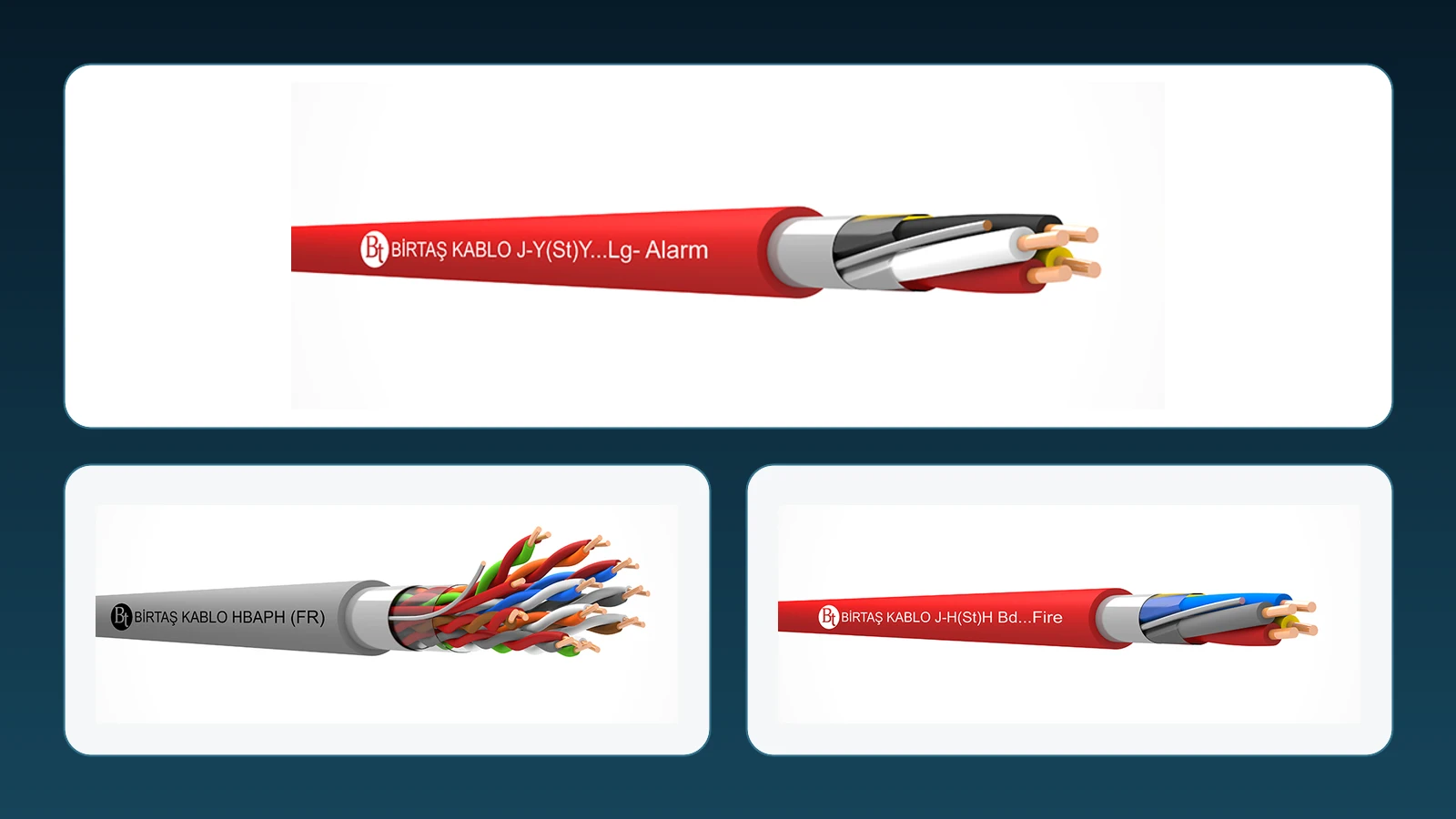
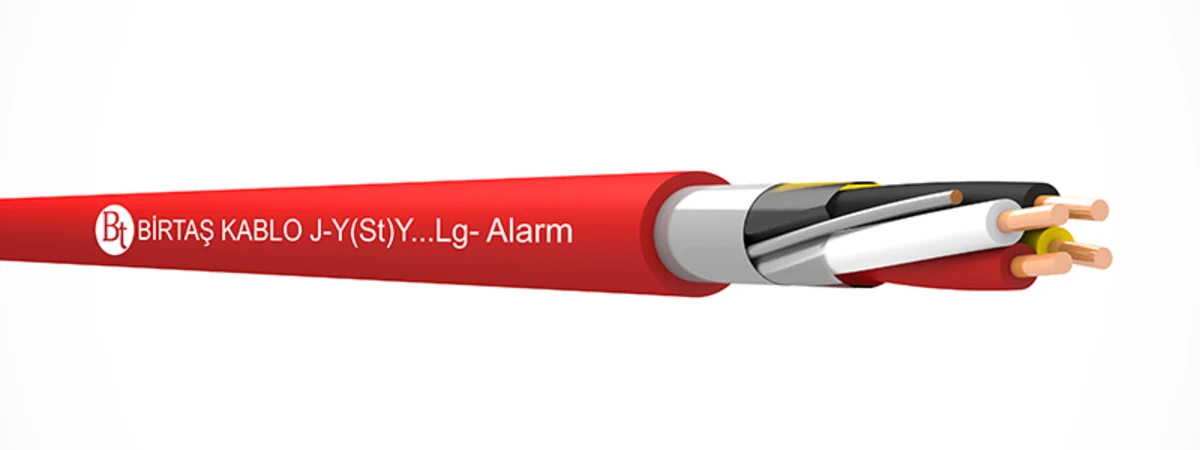
On the J-Y(St)Y…Lg/Alarm product page, this series is described as PVC-insulated, shielded fire alarm system cables. Their primary use is in indoor fire alarm systems for signal and data transmission. Each cable consists of two conductors arranged in pairs, which are laid up in layers in a specific sequence. The shielding layer, made of tinned copper drain wire and aluminum polyester tape, serves to protect against external electrical interference. The outer sheath is a PVC compound that complies with EN 50290-2-22 standards; on the official page, its color is specified as approximately RAL 3000 red.
The values published for this product family provide a concrete basis for selection: the products are designed in accordance with VDE 0815 and TS 13767 standards; the maximum operating voltage is 300 V, and the minimum bending radius is specified as 10 x D. The conductor resistance limits depend on the conductor diameter: for a conductor diameter of 0.60 mm, the maximum resistance is 130 Ω/km; for 0.80 mm, it is 73.2 Ω/km. These values are to be applied exclusively to the relevant cross-sections of this product family and must not be automatically applied to other types of alarm cables.
Fire terminology: distinguish three concepts
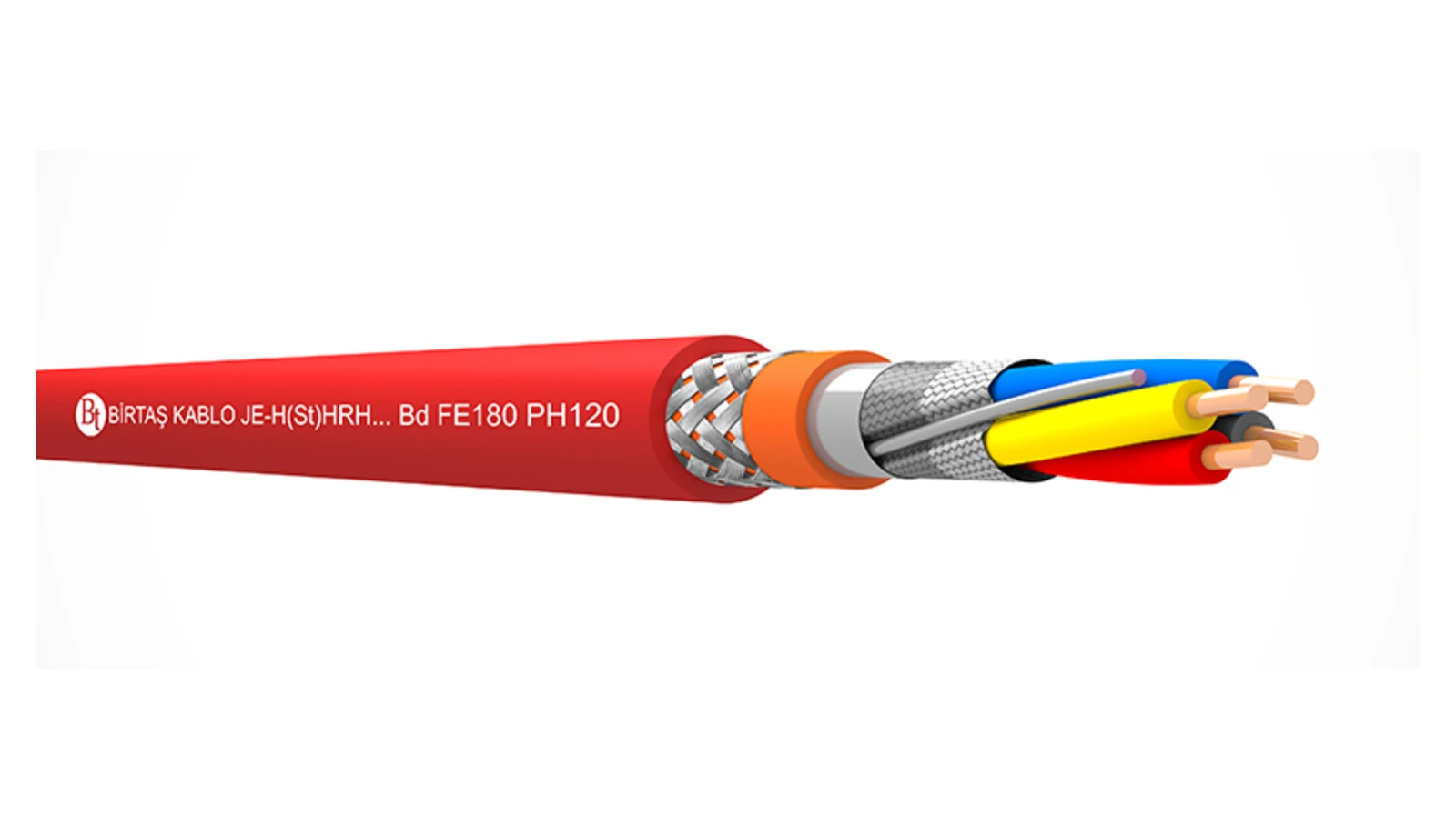
The use of a cable in a fire alarm system does not imply that it will maintain the integrity of the circuit for a certain period during a fire. Terms such as “flame-retardant”, “halogen-free and low-smoke”, as well as descriptions like “maintains its functionality” for products like FE180 or PH120, refer to additional performance criteria that must also be documented. The EN 60332-1-2 and IEC 60332-1-2 standards include flame-retardant testing in their specifications; however, the FE180 or PH120 designation is not mentioned in the referenced documents. Therefore, merely because the product’s name includes “fire alarm” it should not be listed in the specifications as a flame-retardant circuit maintenance cable.
The same principle applies to CPR. The CPR class cannot be determined merely by the category or the color of the sheath; it must be verified based on the product’s exact code, its performance specifications, and the latest technical documentation. Since the materials, class, or construction may vary within the same family, stating merely “halogen-free cable” in the quotation is insufficient. Before placing an order, it is essential to ensure that the selected product matches the required fire class, smoke class, and sub-classifications for droplets and acidity.
J-H(St)H Bd… / Fire: a halogen-free indoor alternative
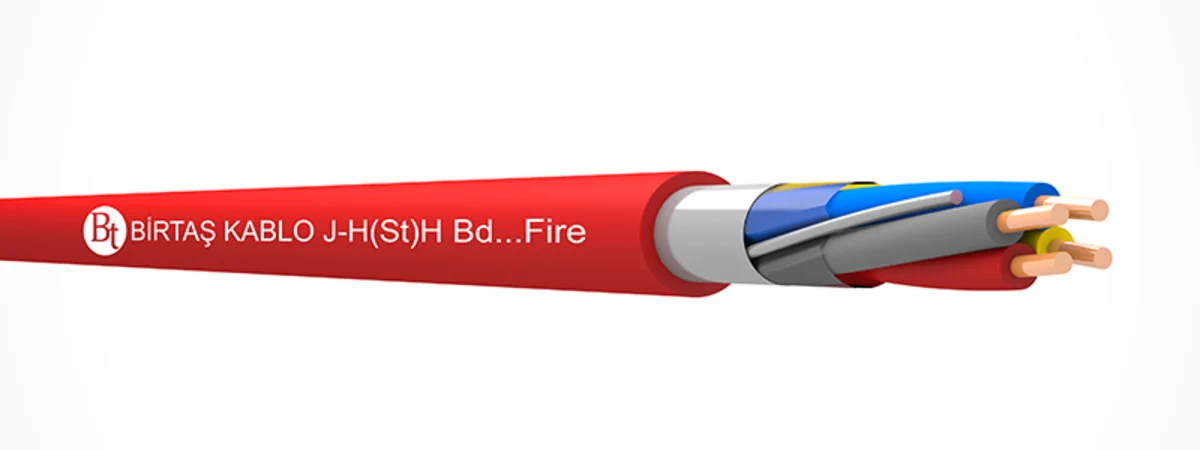
J-H(St)H Bd… is described on the Fire page as a halogen-free, flame-retardant, shielded fire alarm system cable. The twisted pairs can be arranged in groups of four, with each group identified by a numbered label. The insulation material is HFFR compound in accordance with EN 50290-2-26, and the outer sheath is also made of HFFR compound per EN 50290-2-27. The shielding consists of aluminum polyester tape combined with tinned copper drain wires. The official application scope includes indoor fire alarm, signal, data, and telecommunications applications; it does not include direct underground use in external environments.
In this product family, the absence of halogens and low smoke emission should not be confused with the claim of circuit integrity. The HFFR design represents a material selection approach tailored to the requirements of low smoke and low corrosive gas emissions during fires in enclosed spaces. If a project in a hospital, airport, school, or shopping center additionally demands circuit integrity, then a different product family such as the FE180/PH class should be considered, along with the corresponding certifications. The specific test results and variant values for the J-H(St)H Bd… / Fire series must be confirmed against the technical data sheet at the time of ordering.
Conductor arrangements for telephone and subscriber distribution
In PDV/PDV-K indoor telephone cables, four conductors are arranged in a star configuration and twisted together. PDV uses bare copper, while PDV-K employs tin-plated copper as a single conductor. Official specifications indicate that the tin-plated conductor option is particularly suitable for open distribution arrangements in damp indoor areas; however, both types are designated for indoor use only and are not intended for outdoor applications or direct burial. HBH/HBH-K (FR) cables feature a twisted-pair design, HFFR insulation, and an outer sheath. These differences affect both the layout of central office ports and field connection boxes, as well as the methods used for cable termination.
The PDH/PDH-K series represents a range of star-quad, halogen-free indoor telephone cables. According to the official product specifications, cables with 0.50-mm conductors have a maximum conductor resistance of 96 Ω/km, a minimum insulation resistance of 5000 MΩ·km, an impedance of 100 ± 20 Ω at 1 MHz, and a minimum propagation speed of 60%. These parameters represent the technical specifications of this telephone cable series, rather than Ethernet-grade performance. In cases where a project requires the use of analog telephones, dry contacts, low-speed data transmission, or custom manufacturer-specific interfaces, it is essential to compare the actual line parameters specified by the device manufacturer with those listed in the cable data sheet.
Shielded telephone cables: HBAPH and HBAPH-K
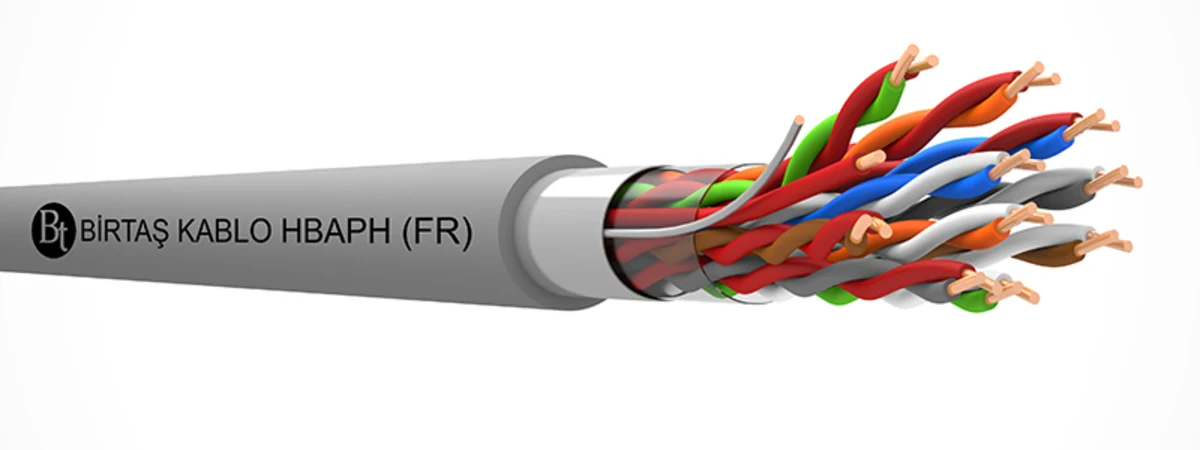
The HBAPH/HBAPH-K (FR) option combines HFFR-insulated twisted pairs under a common aluminum polyester shield and an outer HFFR sheath. The ground wire in the shield facilitates easy termination. On the product page, HBAPH is specified as bare copper, while HBAPH-K is described as tinned copper conductors. For 0.50-mm conductors, the maximum conductor resistance is 97.8 Ω/km, and the nominal mutual capacitance is 120 nF/km. The minimum bending radius is specified as 6 x D when installed fixedly, and 10 x D during installation. These specifications are specific to the HBAPH/HBAPH-K FR product page in question.
The shielding feature is not an independent mechanism that can “completely eliminate interference.” The level of protection actually depends on various factors, such as the cable routing, the separation from power cables, the continuity of the shielding material, the location where the shielding is applied and on which busbar it is connected, the panel’s grounding system, and the device interface. If the shielding installation is not carried out properly according to the project specifications, the expected protection levels may not be achieved, even in the presence of the shielding material. Therefore, instead of simply stating “shielded” in the cable list, it is essential to specify the details of the shielding design, the termination method, and the reference grounding point.
Underground and overhead line families
PD-PAP is an underground telephone cable with PE insulation. According to the official product description, it is intended for use in subscriber lines, signal and protection circuits, as well as in underground conduits that are not continuously submerged in water. It cannot be used as an power cable. The recommended installation distances vary depending on the conductor diameter: 0.50 mm for short distances, and 0.60 mm to 0.90 mm for longer distribution networks. However, this information alone is not sufficient to determine the voltage drop or calculate the required transmission capacity; the actual length of the line must be calculated based on the specific equipment requirements.
PD-AP/A is an overhead telephone cable with PE insulation and messenger wires. The product page describes its outer sheath as UV-resistant PE and lists its applications, including subscriber distribution between poles, as well as for signal and protection circuits. The presence of hanging elements does not automatically ensure compatibility with all spans and climatic conditions. Factors such as pole spacing, sag, wind and ice loads, as well as connection hardware and tension forces, must be considered within the mechanical design process. Underground cables and overhead cables should not be used interchangeably, even though they have similar conductor structures; the latter should not be installed in channels that are submerged in water.
Line calculations and site acceptance
The selection of cables must be verified in accordance with the device’s input and output specifications. The total circuit resistance should be calculated by taking into account twice the length of the single conductor, the resistance of the conductor itself, and any additional connection components. Capacitance can affect the signal rise time over long distances or exceed the circuit limits specified by the manufacturer. For parallel circuits, physical separation, in addition to shielding, is also required for power cables, drives, and contactors. The design should also take into account factors such as cable tray occupancy, sharp bends, additional junction boxes, and any potential pulling forces.
During commissioning, checks are conducted on the continuity of conductors, short circuits, insulation, continuity of the shielding, and proper terminal connections. In the case of fire alarm systems, the loop resistance and topology are tested in accordance with the panel manufacturer’s requirements; specialized testing equipment is used for telephone or data lines. The test results should apply not only to the cable reel but also to the entire installed and terminated cable system. If a CPR or fire certification is required, the delivered reel label, product code, and performance data must be included in the same documentation package.
Oskon's engineering and supply approach
Oskon considers the cable not merely as a consumable material in itself, but rather as a component of the control and security system’s communication infrastructure. The type of cable to be used is determined based on factors such as the I/O requirements, the specifications of the fire alarm panel or communication devices, the route classification, and the field conditions. The number of conductors and pairs, as well as the design features such as spare capacity, shielding, terminal configuration, cable glands, insulation separation, and labeling standards, are all carefully considered during the planning phase. This ensures that there is a clear correspondence between the product specifications and the technical requirements at the bidding stage.
In practice, a reel layout plan, a pulling list, a routing diagram, and a test form are prepared. When it is necessary to replace a cable, not only the cross-section but also the conductor resistance, capacitance, impedance, shielding, sheath, bending radius, and fire resistance specifications must be rechecked. The final product code and the latest manufacturer documentation must be verified before making the purchase. This approach helps to prevent the accidental use of a cable that may appear similar on site but differs in its application or fire resistance characteristics.
Checklist before purchasing
- In which location is the line located: inside a building, in an underground tunnel, or on an overhead route?
- What signal will be transmitted, and what loop resistance and maximum line length does the device allow?
- Do the pair, star-quad, group, and core counts match the project terminal plan?
- What factors determine the choice between bare copper or tinned copper conductors in a given application?
- Is a screen necessary? If so, what are the details regarding termination and earthing at both ends?
- Does the material composition of PVC, PE, or HFFR match the application environment and the requirements specified in the project specifications?
- Have flame retardancy, low smoke, halogen-free properties, CPR classification, and circuit integrity each been verified?
- Are the complete product code, reel label, current data sheet, and performance statement all associated with the same record?
Frequently asked questions
Does a fire alarm cable maintain operation during a fire?
This conclusion cannot be drawn solely from the product name. The J-Y(St)Y…Lg / Alarm and J-H(St)H Bd… / Fire sections specified indicate that the materials possess flame-retardant or HFFR properties; if it is necessary to ensure their functional integrity, separate products and documentation clearly labeled as FE180, PH, or the corresponding class should be selected.
Does every shielded cable provide the same electromagnetic protection?
No. The material used for shielding, the method of termination, the ground wire, the cable geometry, and the on-site installation methods all differ. Moreover, it should not be assumed that each product in this category belongs to the same shielding class, as is the case with coaxial products.
Can an indoor telephone cable be used outdoors inside a conduit?
The official application scope of the product should be taken as the reference. For types such as PDV, HBH, HBAPH, PDH, as well as the examined J-Y/J-H types, they are not suitable for outdoor use or direct burial. For underground applications, purpose-specific families such as PD-PAP should be considered; for overhead applications, PD-AP/A are the appropriate choices.
Official Birtaş Kablo resources
- Current Category Page for Communication and Security Cables
- J-Y(St)Y…Lg / Alarm Product and Technical Information Page
- J-Y(St)Y…Lg / Official technical specification for alarms
- HBAPH & HBAPH-K (FR): Halogen-free shielded telephone cables
- PDV & PDV-K indoor telephone cables
- PD-PAP underground telephone cable
- PD-AP / A overhead telephone cable with hanging wires
- PDH & PDH-K halogen-free telephone cables
- J-H(St)H Bd… / Fire: Product and technical information page