





Selecting the right industrial cable is not merely a matter of specifying the number of conductors and their cross-sectional dimensions. The signal level of the measurement circuit, the electromagnetic environment, the length of the line, the method of installation, temperature factors, mechanical risks, the material of the outer sheath, and the fire protection requirements of the facility must all be taken into consideration within the same order request. Birtaş Kablo’s current portfolio includes instrumentation cables in 300 V and 500 V categories, as well as silicone cables available in single-conductor, multi-conductor, shielded versions, and those specially designed for high-temperature applications. Although these two product groups may overlap in certain applications, they serve different needs: the construction of instrumentation cables focuses on ensuring signal integrity, while the selection of silicone materials is primarily based on their resistance to heat and other environmental factors.
This catalog and selection guide translates the current specifications listed on the official product pages into the language appropriate for the project. The example values provided here are specific to the product family mentioned. The temperature, voltage rating, shielding type, or other specifications of a particular variant must not be transferred to another type of cable. For a confirmed order, it is essential to verify the product code, conductor arrangement, cross-section, approximate outer diameter, minimum bending radius, and the relevant data sheet.
Assess instrumentation and silicone cables against their different purposes
The primary function of an instrumentation cable is to reliably transmit low-level analog and digital signals between field devices and control or measurement systems. Therefore, electrical characteristics such as twisted-pair or triad construction, shielding configuration, mutual capacitance, capacitance imbalance, and conductor resistance are of utmost importance. Birtas Kablo’s official category descriptions classify these products as being suitable for precise measurement, control, and data transmission applications. Their typical uses are listed on the product pages for industries such as chemistry, petrochemicals, energy, natural gas, and oil.
In silicone cables, the starting point for design considerations is different. Silicone insulation and sheathing make these cables particularly suitable for applications that require a wide temperature range, such as in indoor wiring systems, control panels, lighting fixtures, ventilation systems, machinery, industrial ovens, foundries, and similar environments. The product range includes both single-conductor and multi-conductor designs, shielded versions, as well as special types with enhanced mechanical properties due to the use of glass fiber reinforcement. It should be noted that the use of silicone material alone does not automatically make a cable suitable for use in sensitive instrumentation, for applications involving continuous motion, or for ensuring circuit integrity; these specific characteristics must be verified separately on the product selection page.
The first instrumentation cable decision: 300 V or 500 V
The official portfolio categorizes instrumentation cables into two main groups: 300 V and 500 V. Each group may include various material combinations such as PVC/PVC, outdoor-grade PVC, PE/PVC, PE/HFFR, XLPE/PVC, and XLPE/HFFR. The 500 V category also includes specifically designated product families designed to ensure circuit integrity in fire conditions. However, this classification alone is not sufficient for selecting the right product; the electrical characteristics of both the source and the recipient, as well as the installation specifications, insulation system, and laying environment, must all be taken into consideration.
The manufacturer’s product pages state that instrumentation cables are not designed to be connected directly to low-voltage power sources, such as the general mains supply. Therefore, the markings “300 V” or “500 V” on these cables do not indicate that they can be used as power cables. These values merely represent a specific part of the product’s specified electrical specifications. For applications such as loop-powered transmitters, thermocouple converters, valve positioners, or digital field signals, it is necessary to first determine the required signal circuitry and device specifications before selecting the appropriate instrumentation cable.
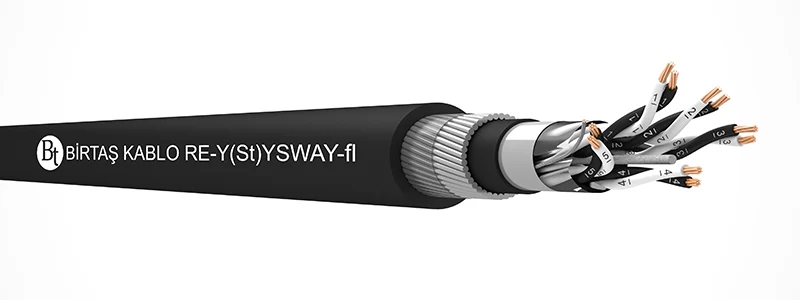
Derive pair, triple and shielding arrangements from the signal chain
The twisted pair is the basic geometry that enables the two conductors to experience external electromagnetic effects in a similar manner. Triad structures can accommodate the wiring arrangements of specific measurement circuits. Simply stating “multiconductor cable” in a project list does not sufficiently describe these geometries. Whether it is a single pair, multiple pairs, or multiple triads, it must be specified in conjunction with the wiring diagram of the field equipment and the spare-conductor policy. The type of conductors or their arrangement also directly affects the termination time and the risk of errors.
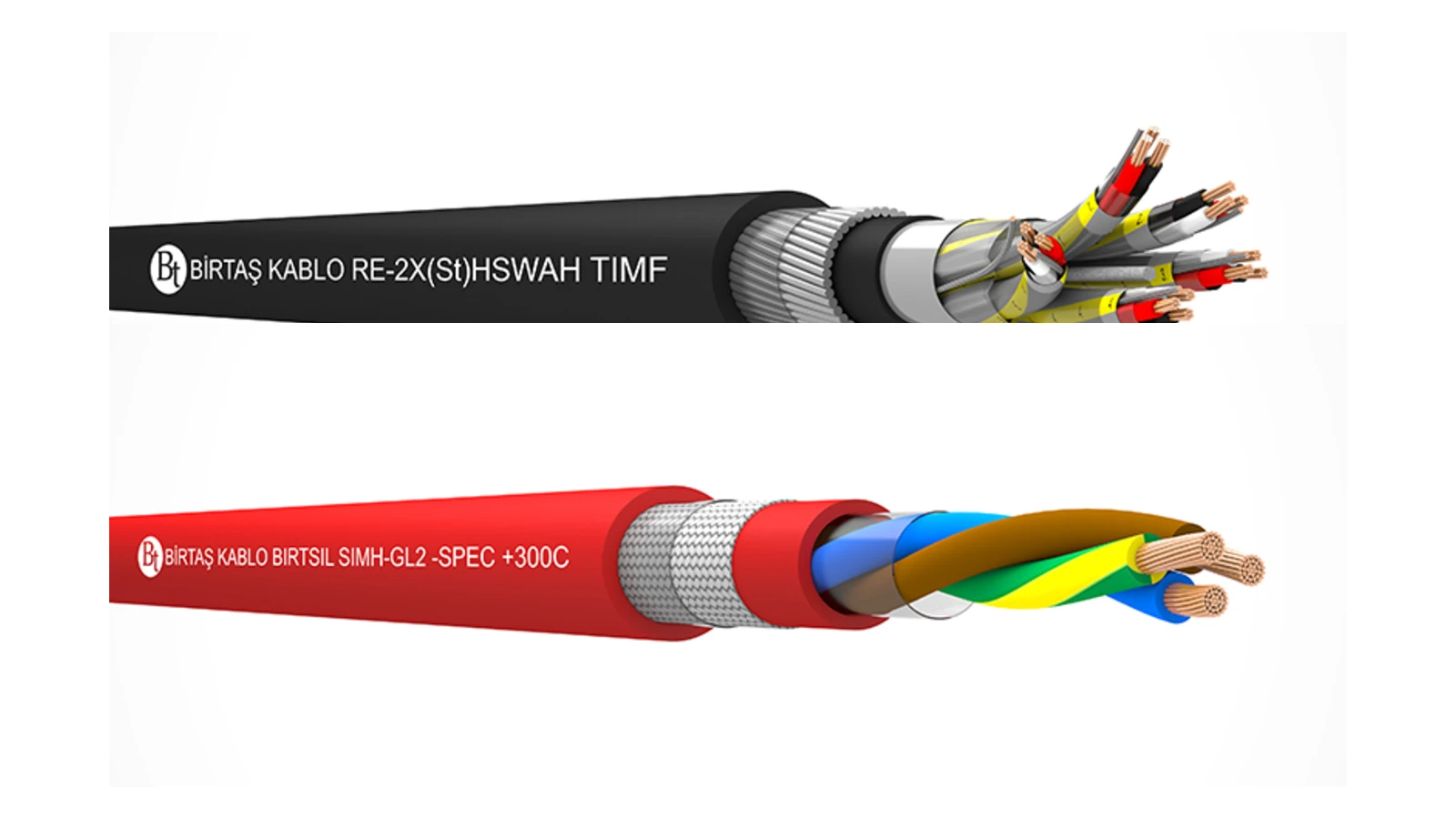
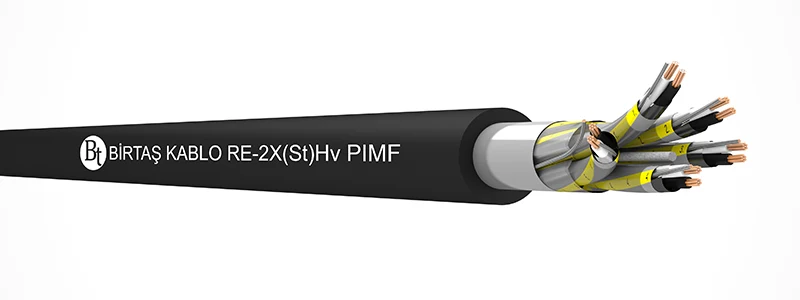
The overall shielding layer surrounds all the laid-up cores with a common metallic coating. The term “PIMF” refers to structures where pairs are individually shielded, while “TIMF” denotes structures where triads are individually shielded; some products also feature additional overall shielding. In Birtaş Kablo’s official example for 500 V PIMF cables, each pair of components is shielded using aluminum polyester tape together with tinned copper drain wires, and an additional overall shielding layer is applied around the entire bundle. This design helps to control interference between different signal circuits and external interference. However, the specific terminal or method of grounding the shielded cable in the field is not determined by its name alone but is determined by the site’s EMC and equipotential bonding requirements.
Shielding and armor serve different purposes. A screen is primarily a means of managing electrical interference, while steel-wire or braided armor constitutes a form of mechanical protection. Certain metal armor configurations may also contribute to electromagnetic performance, but this should not imply that they perform all the functions of a dedicated shielding layer. Factors such as cable tray installation, conduit types, external environments, underground conditions, as well as the risks of rodent damage or impact, must all be specified separately before placing an order.
Match insulation and outer sheath materials to route conditions
Instrumentation families with PE or XLPE insulation, available in PVC or HFFR/LSZH outer sheathing options, cater to various application scenarios. The terms HFFR and LSZH refer to materials that generate minimal smoke and are free from halogens; however, these designations alone do not indicate whether a product is suitable for outdoor use, direct burial, exposure to oils, UV radiation, or specific fire resistance requirements. Official product descriptions may specify reinforced models approved for outdoor and underground installations, as well as cables designed solely for indoor use.
For example, the RE-2X(St)Hv PIMF 90°C / 500 V product features a Class 2 stranded copper conductor, XLPE insulation, and an HFFR outer sheath with individual pair and overall shielding. The official product page specifies options for black or blue outer sheaths, as well as the material’s resistance to oil and UV radiation. It also outlines the applicable installation scenarios, including indoor, outdoor, and underground applications. The page provides additional technical data such as the operating temperature range of −40°C to +90°C, the installation temperature range of −5°C to +50°C, and a minimum bending radius of 7.5 × D. These specifications apply specifically to this product and are not universally valid for the entire range of instrumentation products.
Silicone cable options: single-core, multicore and special protection
The single-conductor BIRTSIL SIF series is described on the official product page as featuring a tinned, bendable Class 5 copper conductor and a silicone insulation structure. The page lists options for 300/500 V and 0.6/1 kV ratings. The temperature range is specified as −60°C to +180°C for fixed installations, and −25°C to +160°C for flexible applications. The minimum bending radius is 6 × D for fixed installations and 15 × D for flexible applications. This product is suitable for use in panel-mounted connections and fixed internal wiring in high-temperature environments; the cross-sectional data for the selected voltage rating should also be checked.
On the BIRTSIL SIMH multi-conductor page, the products are described as consisting of Class 5 copper conductors, silicone insulation, a multi-strand conductor assembly, and a silicone outer sheath. The products are available in 300/500 V and 450/750 V voltage ranges. The official technical specifications include different requirements for fixed and flexible applications, bending radii of 6 × D and 15 × D, and a maximum operating temperature of +180°C for the conductors. It is important to note that these values do not imply the cable can perform “continuous robotic movements.” The flexible temperature range indicated on the page does not replace the results of dynamic cable tests, which determine the cable’s performance under various conditions of movement, speed, acceleration, and bending cycles.
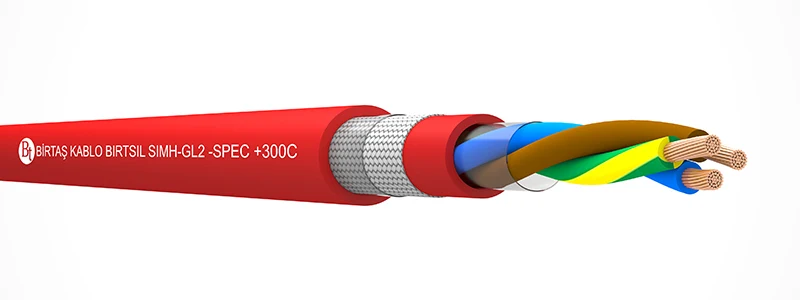
The BIRTSIL SIMH / GL2 / SPEC product, with its glass fiber yarn weave structure, offers superior thermal and mechanical properties. The manufacturer’s website lists its features as including a special silicone insulation and sheath, as well as a silicone inner layer and a glass fiber weave layer. The same page specifies temperature ranges for use: +300°C for fixed applications, and −25°C to +250°C for flexible applications. It should be noted that this upper temperature limit is not applicable to standard silicone products in the same family but is specifically designated for this particular model and its current variants.
Distinguish ambient, conductor and moving-operation temperature ratings
When evaluating the temperature of a cable, the factory-set value alone is not sufficient. The actual ambient temperature along the cable’s path, the heat generated by the current flowing through the conductor, as well as factors such as ventilation, bundling, and contact with hot surfaces must all be taken into consideration. The terms “conductor operating temperature,” “fixed operating range,” and “flexible operating range” on the product page refer to different numerical values. Moreover, the temperature during a short-circuit event is not considered within the continuous operating range. For example, a high temperature value specified for a brief short-circuit lasting a few seconds on the data sheet does not imply that the cable can operate at that temperature for an extended period of time.
Although silicone cables can maintain their flexibility over a wide temperature range, the use of incorrect clamps, sharp edges, overly tight cable glands, or too small a bending radius can reduce their lifespan. Glass fiber reinforcement, when used in a specially designed configuration, can enhance their mechanical properties; however, it does not provide unlimited resistance to tensile or shear forces. When installing such cables, it is essential to refer to the product specifications regarding the recommended temperature range and minimum bending radius. In the case of connections in vibrating machinery, it is also necessary to specify the type of motion and the number of cycles involved.
Heat resistance, flame retardance and circuit integrity are different
The selection of high-temperature-resistant silicone cables does not automatically ensure that a circuit will remain operational for a certain period during a fire. The flame-retardant test evaluates the behavior of the flame on the cable; the halogen-free and smoke characteristics refer to the combustion products; while circuit integrity is determined by the ability of the electrical system to function during the fire test. On some of Birtaş Kablo’s silicone product pages, specifications in accordance with EN 60332-1-2, EN 60754-1/-2, or IEC 60331 are listed. These specifications must be verified for each individual product and variant, and should not be solely inferred from the word “silicone” alone.
Similarly, the HFFR outer sheath alone does not indicate the reaction-to-fire classification of a construction cable or the duration of circuit integrity. Where required by building materials regulations, the performance statement, label, and relevant Euroclass information must be verified for the specific product code ordered. In emergency applications, the entire transmission system, including accessories, connections, routing, and installation methods, must also be consistent with the project documentation.
| Application requirement | Initial product approach | Critical verification before quotation |
|---|---|---|
| Low-level analog measurement systems | Paired instrumentation cable; PIMF and overall shield if required | Capacitance, shield arrangement, line length, voltage group, and EMC earthing plan |
| Common pathway for multiple signals | Multi-pair or multi-triad construction | Pair/triad identification, individual shields, spare groups, and outer diameter |
| External environments or mechanical hazards | On the product page, it is indicated as a type suitable for outdoor use and featuring appropriate protective coatings/shells. | UV, moisture, chemicals, permission for direct burial, cable glands, and armor termination |
| High-temperature connections inside the control panel. | Single-core silicone cable with appropriate voltage rating and cross-section. | Fixed temperature range, current-carrying capacity, color, bending ability, and compatibility with terminals. |
| Multi-conductor connections in the vicinity of ovens or foundries | SIMH or specially designed silicone materials suitable for the respective environment. | Actual route temperature, movement, exposure to oils/chemicals, type of outer sheath, and methods of protection. |
| A special temperature point approaching 300°C | Only the relevant special 300°C product family. | Fixed/flexible limit, glass fiber mesh, terminal temperature, and product code. |
Technical information required for the quotation package
- Describe the circuit: Indicate whether it serves for analog, digital, data transmission, control, or power supply purposes; also specify the device type and its nominal operating parameters.
- Specify the geometry: Indicate the number of pairs, triples, or conductors; also specify the cross-section, shielding, and spare components required for different applications.
- Document the route: Indicate risks related to internal/external environments, pans, channels, underground conditions, moisture, water, UV radiation, oil, chemicals, impact, and rodents.
- Measure temperature: Please provide the normal and maximum ambient temperatures, as well as the temperature values in the vicinity of hot surfaces during bundling and handling.
- Describe the movement: Specify fixed installation, occasional flexing, continuous linear movement, or torsion, together with bend radius and expected cycle life.
- Distinguish between fire targets: Do not combine the requirements for flame retardancy, low smoke/halogen emissions, CPR classification, and circuit integrity under the same “fire-resistant” category.
- Verify the mounting interface: Check cable diameter, gland clamping range, shield or armor termination, terminal conductor range, and cable numbering.
- Request the documentation set: Before placing an order, please ensure that the product code you have been offered corresponds to the current data page and that it possesses all the necessary compliance documents required for the project.
Oskon approaches the selection of instrumentation and silicone cables in a more comprehensive manner than simply adding the cable name to the product list. By considering the signal function, routing, temperature range, and termination design within a unified technical framework, Oskon ensures that neither an unnecessarily heavy cable is chosen nor any critical aspect is overlooked. The final product is tailored to the specific project requirements, in line with the specifications and limitations outlined on the official product page. Additionally, the availability of the cables and any options for custom production are confirmed at the time of the quotation.
Official technical resources
- Birtaş Kablo – Instrumentation cables category
- Birtaş Kablo – 300 V range of instrumentation products
- Birtaş Kablo – 500 V range of instrumentation products
- Birtaş Kablo – Product page for RE-2X(St)Hv PIMF, 90°C / 500 V
- Birtaş Kablo – Silicone Cables Category
- Birtaş Kablo – BIRTSIL SIF product page
- Birtaş Kablo – BIRTSIL SIMH product page
- Birtaş Kablo – BIRTSIL SIMH / GL2 / SPEC: high-temperature resistant products
Technical specifications may vary depending on the selected product code and cross-section. Before designing and placing an order, it is essential to refer to the current data sheet available on the official website.