





Line starvation and waiting
When a material call is formed late or incorrectly prioritized, the production station waits for feed even if equipment is ready.
We automate line feeding, work-in-progress transfers and finished-product outfeed by coordinating AMRs, AGVs, conveyors and transfer stations through shared task management.
Explore the solution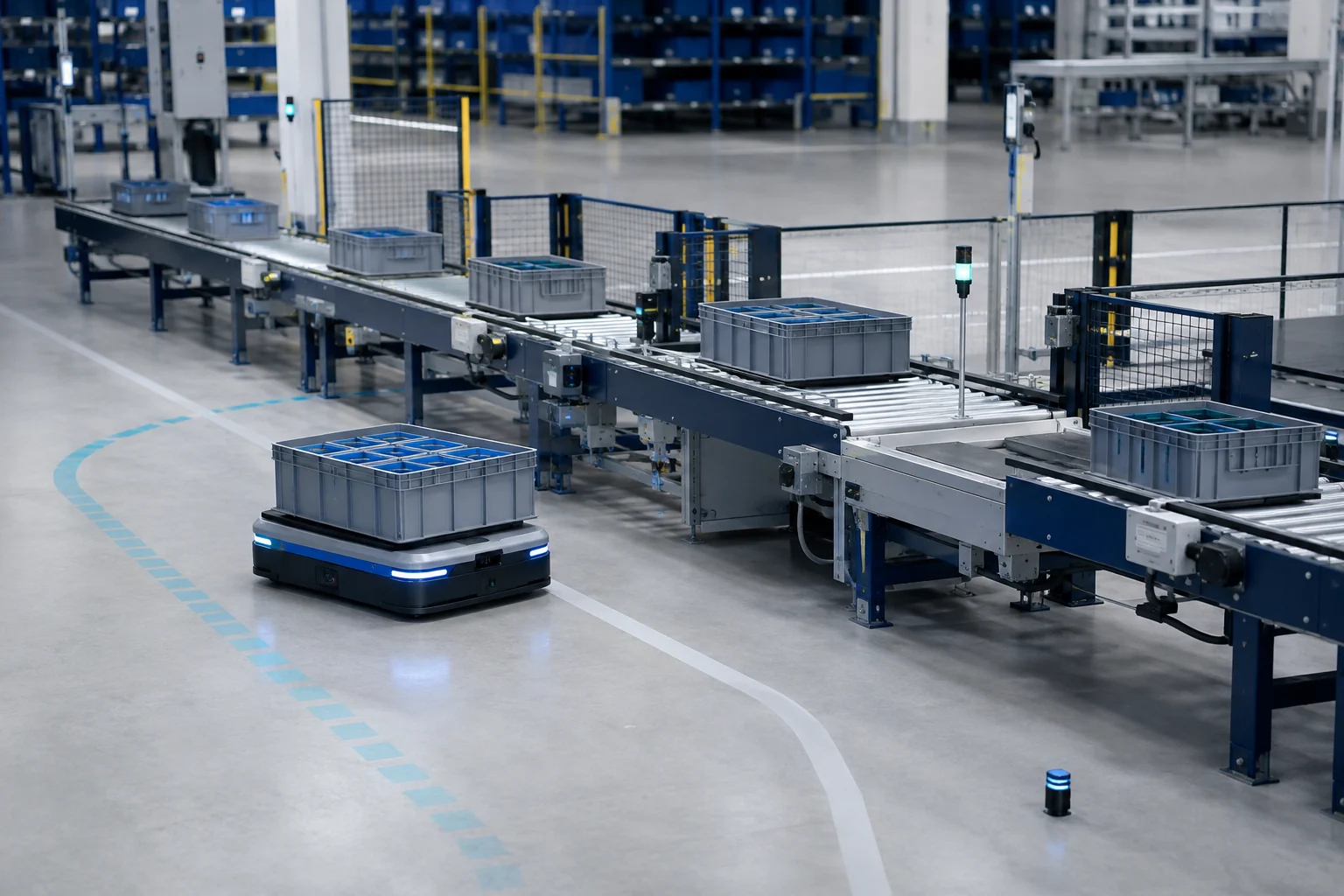
When a material call is formed late or incorrectly prioritized, the production station waits for feed even if equipment is ready.
When frequently repeated fixed transport assignments intersect with pedestrian paths and production areas, safety, space, and operational discipline weaken.
When the production order, warehouse movement, and transport task remain in different systems, it is difficult to deliver the right load to the right station.
Line feeding is not just moving from point A to point B. Material demand, load identity, equipment suitability, traffic conditions and station capacity are assessed in a common task flow.
Production, kanban, a call button or a higher-level system provides the required material and timing information.
→The appropriate transport resource is selected according to priority, route, equipment type, battery state and traffic conditions.
→Mobile robots, AGVs, conveyors or hybrid arrangements perform the task using defined handshake signals.
→Cargo, station and work order matching is checked; inventory and job record is updated.
Fixed, continuous flows and variable routes may require different transport technologies within the same factory.
Repeated routing, high frequency and defined load interfaces provide uninterrupted transfer.
It performs regular transport in fixed source-target pairs, with defined routes and controlled traffic structure.
It provides flexible movement on variable routes, at multi-mission points and in the need of incremental growth.
Rollers, chains, lifts, tooling and sensors provide mechanical and digital verification of load pickup and drop-off.
Interim stock, full-empty carrier separation and queue management buffer changes in production rhythm.
ERP, MES, and WMS requests are translated into equipment tasks; priority, traffic, and exceptions are centrally managed.
Continuous or call-based movement, route length, and source-target number are evaluated together.
Verify the dimensions, weight and transfer method of each pallet, crate, tote, trolley or special fixture.
The new station, product range, shift and how to add capacity increases to the system are planned.
Pedestrian traffic, escape routes, charging, fault recovery and manual backup scenarios are designed.
Source, destination, load type, transport frequency, peak period and empty returns are mapped.
Define takt time, buffers, waiting times, call timing and the acceptable delivery window.
Conveyor, AGV, AMR and transfer stations are selected according to the needs of each task profile.
Route intersections, charging, queue, station occupancy and equipment number are tested with scenarios.
ERP/MES/WMS messages, station handshakes, and error recovery flows are tested within the FAT/SAT framework.
Line or area-based transitions are made; performance is monitored to improve route and mission rules.
Supply of raw materials, components, kits and packaging material to the station according to production needs.
Transfer of semi-finished products between operations with preservation of identity and process sequence.
Collection, sorting and recirculation of crates, pallets and production trolleys.
Transfer of loads from the line exit to the quality, warehouse or delivery area in the correct order.
Tell us briefly about your operation so we can establish the right next step together.
Discuss your requirements Your request is routed directly to the relevant engineering team.
Engineering confidence with Oskon.
Leave your details and our expert engineers will contact you for a preliminary consultation tailored to your needs.