




Variable product profiles
Products with different dimensions, weights, packaging and code quality must be processed reliably on the same line.
Intelligent sorting lines combine conveyors, detection, PLC, motion control and WCS layers within one synchronised architecture to route high-volume product flows accurately.
Explore the solution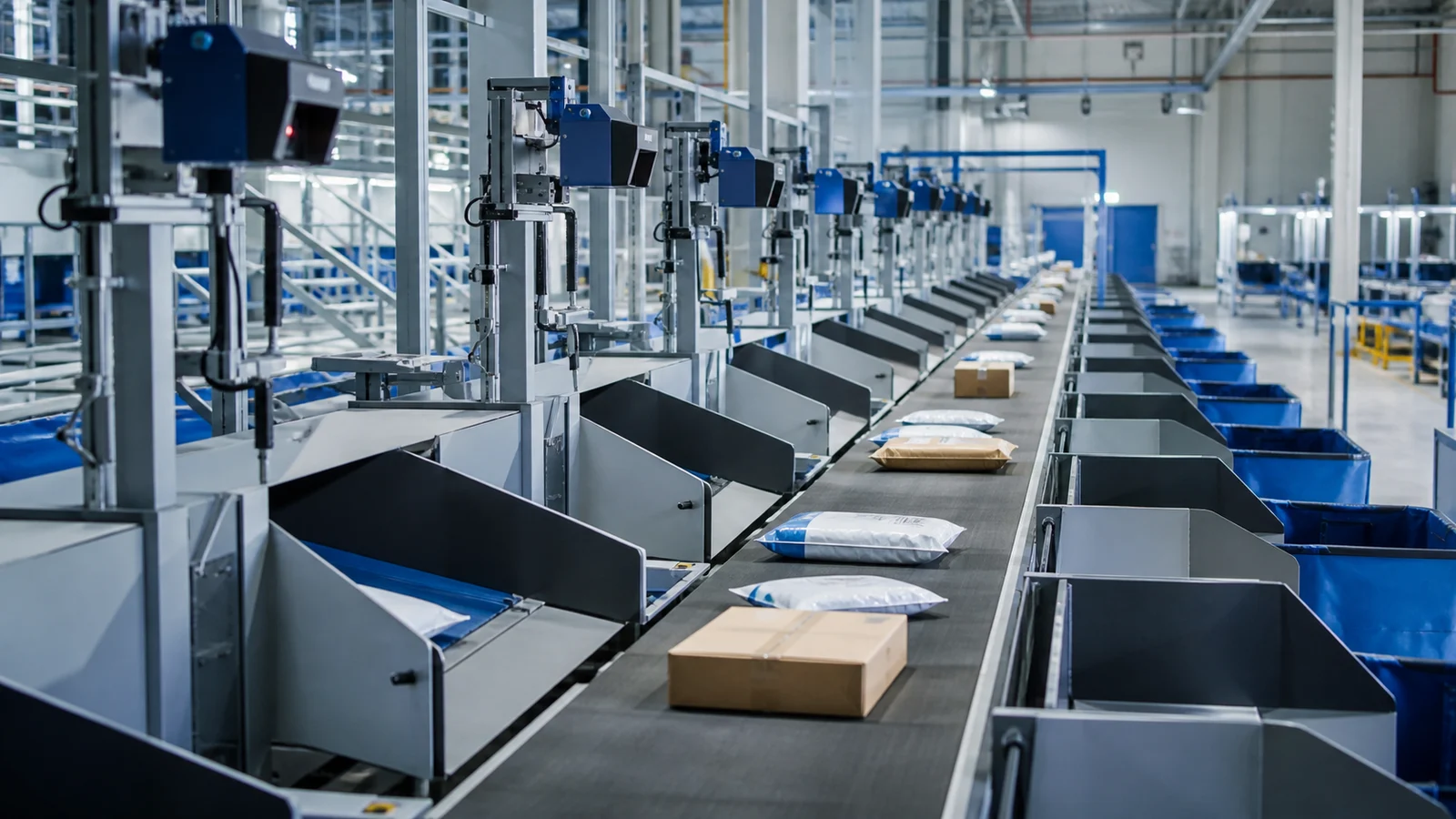
Products with different dimensions, weights, packaging and code quality must be processed reliably on the same line.
Irregular infeed, full destinations and poor timing reduce capacity and disrupt product spacing.
Reading, decision or divert errors can route a product to the wrong order, route or dispatch gate.
An intelligent sorter combines conveyors, sensors, code reading, measurement, PLC and WCS layers within one synchronised flow. Position, destination and sorting result are managed simultaneously for every product.
The graphic shows the real flow from reading the product at the infeed sensor to target assignment by the control system and timed diversion to the correct destination.
Capacity depends on more than sorter speed. Infeed geometry, product spacing, read rate, destination occupancy and control latency are engineered together.
Realistic line capacity is modelled from product profiles, peak volume, queue behaviour and destination distribution.
Merge, singulation, transport and divert mechanisms are sized according to product behaviour.
Barcode, vision, volume, weight and sensor data are matched to the product's digital record.
Encoder position, product tracking and divert timing are managed with deterministic control logic.
WMS, MES or ERP destination decisions are combined with line status and exit availability in real time.
No-reads, rejects, occupancy, cycles and downtime causes are reported for continuous improvement.
Sensor feedback is checked after the product is diverted. A no-read, full destination or timing deviation can route the product to a controlled reject or recirculation path.
Sensors and encoders track the product digitally.
→The order and destination availability are evaluated together.
→The divert mechanism is triggered in synchronisation with product position.
→Arrival is detected, the decision verified and the transaction recorded.
Dimensions, weight, packaging, volume distribution and peak scenarios are mapped.
Infeed, merge, sorter and destinations are validated within one flow model.
Mechanical, electrical, control, network and host-system integration are developed together.
Normal flow, no-read, full destination, reject and safety behaviours are tested.
Timing parameters are tuned with real products and acceptance criteria are verified.
Line data is monitored to reduce bottlenecks, errors and availability losses.
High-volume sorting of parcels by route, region, distribution centre or dispatch gate.
Order picking, consolidation, cross-docking and store-based product routing.
Routing parts, totes and products by production order, quality result or next operation.
Controlled sorting by grade, weight, recipe, packaging or quality data.
Customer and facility information has been anonymized to meet confidentiality obligations.
Share load profiles, throughput targets and space constraints so the right architecture can be assessed.
Request a storage and flow analysis Your request is routed directly to the relevant engineering team.
Engineering confidence with Oskon.
Leave your details and our expert engineers will contact you for a preliminary consultation tailored to your needs.