






Repeated high-frequency access
Distributing small and medium materials across separate racks recreates search and walking time during every picking task.
A VCM moves all chain-connected carriers through one vertical loop and presents the selected shelf at an ergonomic access opening.
Explore the solution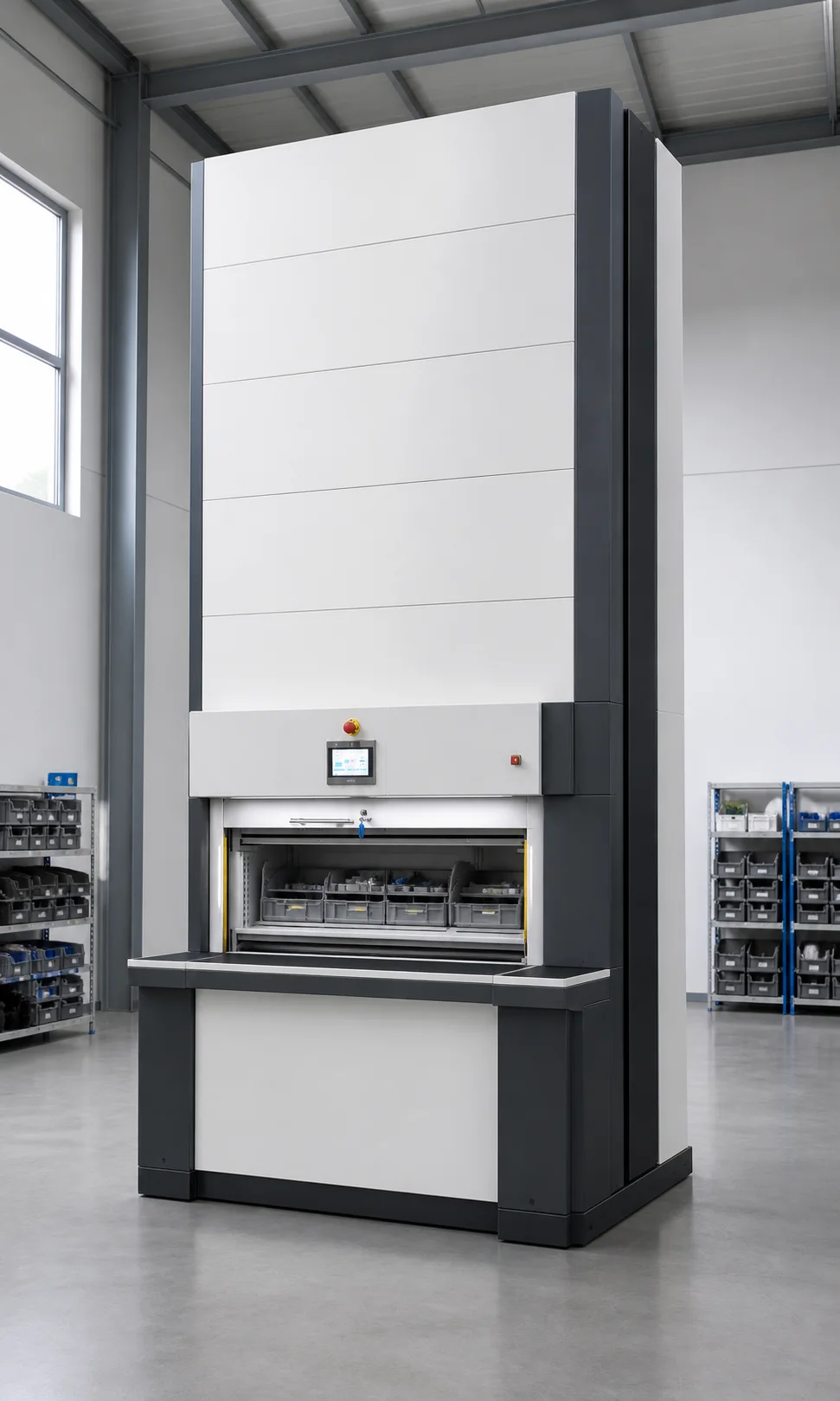
Distributing small and medium materials across separate racks recreates search and walking time during every picking task.
When standard bins and parts are not managed in one carrier structure, usable vertical volume and location discipline decline.
Manual access to high or low shelves creates physical strain, while incorrect locations and missing records compound errors.
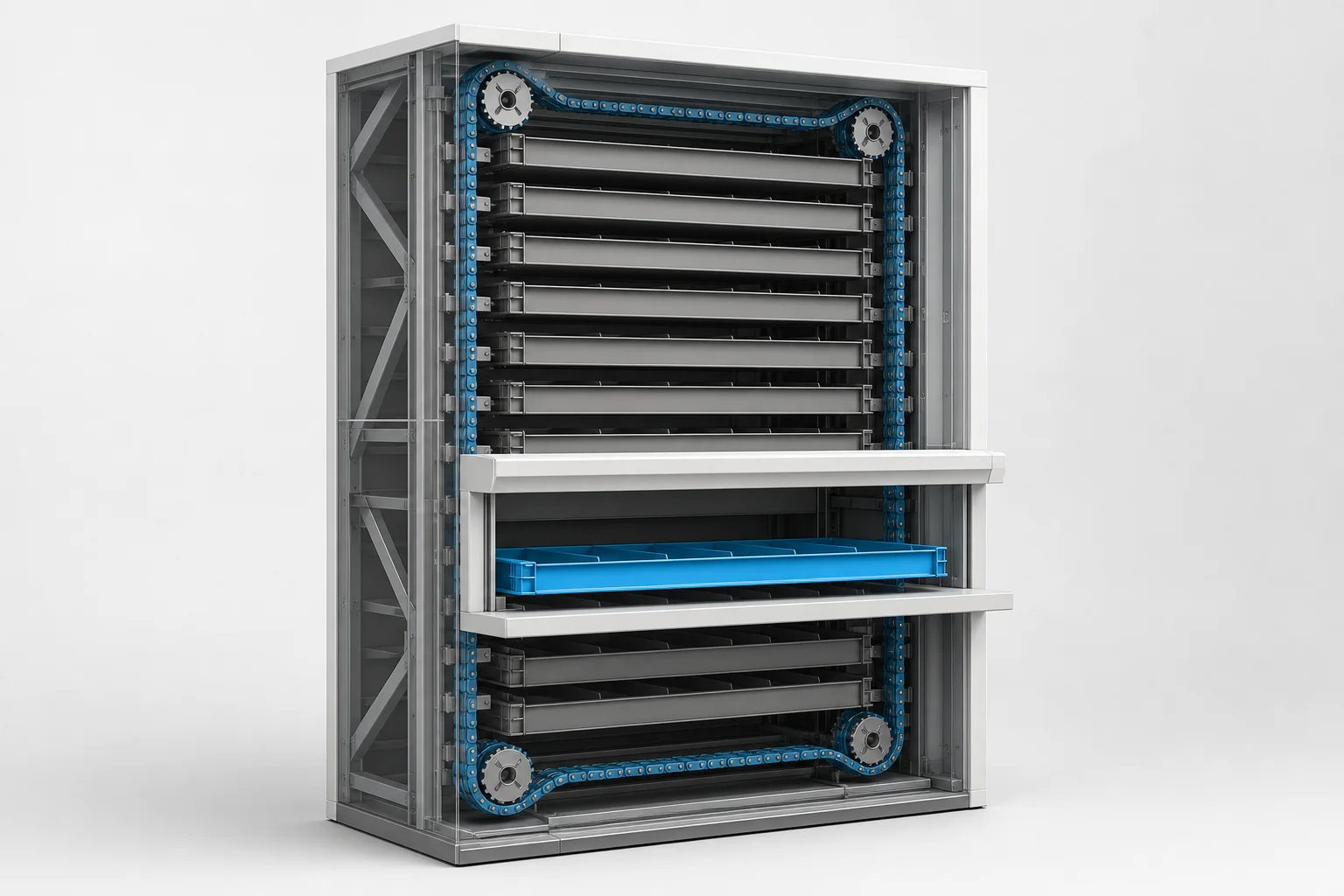
In a VCM, shelf and drawer carriers form one vertical loop connected to support chains on both sides. The control system selects the travel direction that reaches the requested carrier by the shortest route and presents it at the fixed operator opening. This architecture is particularly suited to similarly sized, frequently accessed small and medium stock.
The values below apply to the reviewed heavy-duty VCM configuration. Dimensions and capacities can differ for other carrier, temperature-control and application configurations.
Sizing note: Forty carriers and a 300 kg carrier rating must not be multiplied to derive system capacity. The 9,000 kg machine limit, load distribution and individual carrier limits apply together in every configuration.
The decision should consider SKU dimensions and weight, access frequency, total inventory, building geometry, ergonomics and integration targets together.
Each tray is requested independently and the central lift moves only the selected tray. This approach stands out for loads of different heights and weights and for multi-floor access scenarios.
Explore the other technology ↗Chain-connected carriers rotate together. This approach stands out for ergonomic access to frequently used small and medium stock with similar dimensions.
You are viewing this pageWe evaluate the documented standard architecture separately from project-specific equipment choices to define the correct scope.
The control system selects the appropriate direction around the vertical loop to reach the requested carrier.
Carriers move together on support chains and the selected shelf stops at the access opening.
Single- or dual-level layouts, dividers, transparent front panels and telescopic drawers can be configured around the product.
Material arrives at a fixed working height, reducing walking between racks, bending and reaching.
The reviewed VCM architecture includes safety light curtains and an operator console protecting the access opening.
Product, user, location, picking and replenishment records can be linked to inventory software and higher-level systems.
Browser-based inventory software provides a control layer for product and location mapping, picking and replenishment lists, stock and expiry-date checks, dynamic inventory and system self-diagnostics. WMS data scope and update behaviour are defined within the project.
A product or work list arrives from the local interface or a higher-level system.
→Inventory software matches the product to its tray or carrier location.
→The VLM transfers the tray; the VCM positions the carrier loop.
→The picking or replenishment result becomes a stock movement and transaction record.
Evaluate access frequency, dimensional similarity, carrier load, total load and storage conditions together.
Configure shelves, drawers, dividers, front panels and the ergonomic opening around actual product geometry.
Check per-carrier load and the 9,000 kg total-system limit within the same load plan.
Define light-curtain, user-authorisation, emergency and maintenance-access scenarios.
Design product-master, picking and replenishment-list, and stock-movement data exchange for the project.
Test rotation, stopping accuracy, load, safety, fault recovery and user flows with real products.
Manage frequently used small and medium maintenance materials in a rapid-access loop.
Store similarly sized production tools, fasteners and electronic components in divided carriers.
Combine product, expiry-date and transaction tracking with controlled storage in an application-specific configuration.
Engineer positive-temperature storage requirements from +2 °C to +10 °C in the temperature-controlled configuration.
Customer and facility information has been anonymized to meet confidentiality obligations.
Share load profiles, throughput targets and space constraints so the right architecture can be assessed.
Request a storage and flow analysis Your request is routed directly to the relevant engineering team.
Engineering confidence with Oskon.
Leave your details and our expert engineers will contact you for a preliminary consultation tailored to your needs.