






Although stainless steel and EMC panel solutions are categorized under the same product title, they address two different design requirements. When selecting a stainless steel enclosure, factors such as environmental compatibility of the material, surface quality, sealing performance, and ease of cleaning are of primary importance. For EMC panels, the electrical continuity of the enclosure’s joints, the conductive inner surfaces, and the design of the electromagnetic seals are decisive. In Tempa Pano’s official product portfolio, the stainless steel panel series—SSAS, SSETS, SSJB, and SSKPA—are listed separately; the hygienic solutions are presented on a dedicated product page under the HS Series. On the EMC side, wall-mounted ESE and freestanding BSE solutions are available; the latter series is also listed on the website under the name ASE. Rather than assigning a single technical specification to all stainless steel series, this guide focuses on examining the SSETS series in detail for Tempa Pano, and ESE and BSE solutions for EMC. For any given project, the required alloy composition, IP rating, EMC compliance, the specific series to be used, and the complete configuration must be carefully determined.
Construction of SSETS stainless steel wall-mounted enclosures
On the official technical page for the SSETS series, it is specified that the body and doors are made of 304L stainless steel in compliance with the EN 10088 1.4307 standard. The thickness of the body and doors is 1.2 mm. The optional mounting plates are manufactured from EN 10346 DX51D+Z galvanized steel, with thicknesses of 1.5 or 2 mm depending on the specific model. The outer surface is described as having a “stainless steel finish.” The protection class is IP66, and references to TS 3033 and EN 60529 are provided. These technical specifications are unique to the SSETS series. Since the material quality, thickness, door geometry, or protection class may vary in other stainless steel series, the term “stainless steel control panel” alone is not sufficient as a clear description for purchasing purposes.
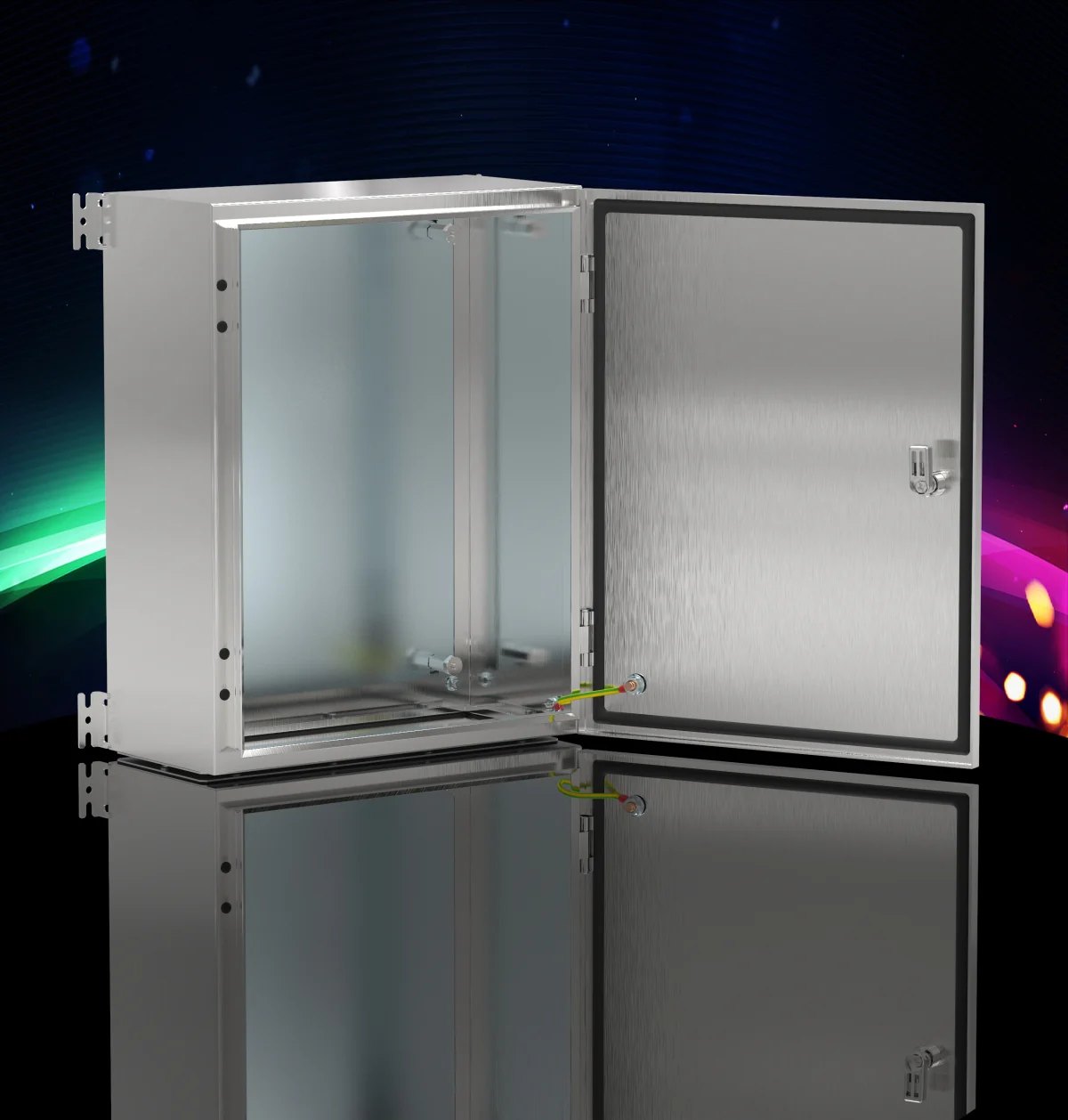
The SSETS body is manufactured by welding, and the product is available in a solid-door or glass-door version. The door is equipped with a polyurethane molded gasket, a hidden hinge that allows 135-degree opening, and a 5-mm, double-bit chrome-plated lock. At the bottom, there is a cable pass-through plate, along with a one-piece PE gasket designed for this plate. The complete assembly consists of the body, the selected door type, the gasketed cable pass-through plate, and four or six wall mounting components, depending on the dimensions. Since the mounting plate is designated in the product documentation as “Option ≈ M,” the choice of mounting plate and its thickness (1.5–2 mm) must also be specified in the order details. Special dimensions, pre-treated surfaces, custom locks, and custom mounting plates are available upon request. Additional accessories include an external cover, feet, DIN rails, an interior door profile, a wall mounting bracket, a cover for the fuse holder, as well as locks, keys, and earthing conductors.
Why the series designation matters when selecting stainless steel
The specification “304L” is a material detail clearly provided by the manufacturer for the SSETS series; however, this information should not be automatically applied to the entire Tempa stainless steel product portfolio. When selecting stainless steel products, the chemical composition of the surrounding environment, the cleaning methods, temperature levels, salinity, the risk of surface deposits, and the cleaning agents to be used must be specified by the project owner. Subsequently, these parameters should be compared with the alloy composition and surface treatment specifications listed in the manufacturer’s relevant product catalogs. It is also essential to verify whether the cable glands, locks, connectors, and other additional components on the control panel are compatible with the specific environmental conditions. Just because the main body of the device is made of stainless steel does not mean that accessories made from different materials will possess the same durability. Options such as pole mounting, caps, or bases available for the SSETS series should also be specified in the order based on the actual installation location and mechanical loads of the device.
Installation details that maintain IP66 protection
The IP66 rating of SSETS is assessed in conjunction with its standard body design and the sealing components specified by the manufacturer. The polyurethane injection seal on the door and the one-piece PE seal on the cable access plate are key components of this overall protection system. The location of holes to be drilled on-site, the protection level of the used cable glands, the tightness of the cable connections, and the proper sealing of any unused openings all affect the final performance of the product. It is essential that the sealing surfaces on the door are free from debris or deformations, that the lock applies even pressure, and that the connecting plates are properly fitted. These requirements are not claims regarding new product features, but rather key aspects of the installation process that must be ensured to maintain the IP66 protection level specified in the catalog. Therefore, it is particularly important to clarify the cutting plans before production if any special pre-treatment options are to be used.
ESE series: wall-mounted EMC enclosures
The Tempa ESE series is designed for wall-mounted EMC applications. According to the official product page, the body, door, and mounting plate are made of 1.5-mm-thick EN 10346 DX51D+Z galvanized steel. The outer surface is painted with RAL 7035w powder coating, while the inner surface remains uncoated. The protection class is IP65, and the design complies with TS 3033 and EN 60529 standards. The fully enclosed door is equipped with an EMC gasket. The door opens 135 degrees on hidden hinges and is secured by a 5-mm-diameter double-bit metal lock. The standard configuration includes the body, the door with EMC gasket, the mounting plate, and four wall mounting accessories. Special dimensions, custom colors, pre-treated surfaces, and customized mounting plates are available upon request.
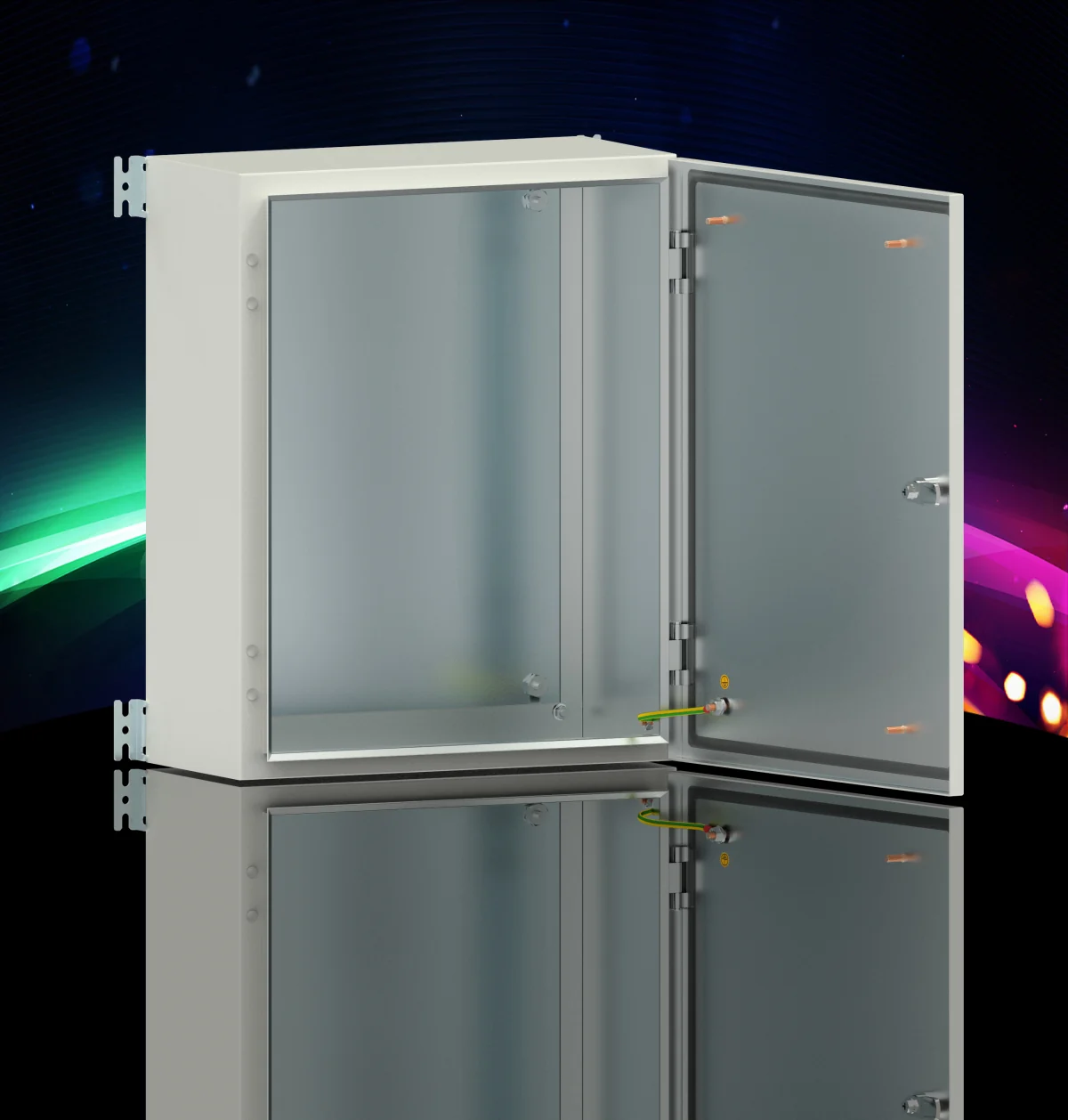
ESE offers DIN rails, internal mounting profiles, and grounding conductors as complementary accessories. In an EMC-compliant enclosure, it is not sufficient to consider only the thickness of the outer metal sheet. The conductive inner surface specified by the manufacturer, along with the EMC gasket, are essential components that ensure the continuity required between the door and the enclosure body. Factors such as holes, cuts, painting, gland plates, or other sealing elements can affect this structure. Therefore, when preparing a pre-production plan, both the mechanical layout and the EMC continuity must be taken into account—the door, enclosure body, mounting components, and grounding system should be considered as a cohesive whole. The final EMC performance depends not only on the empty enclosure itself but also on the devices installed inside, the way cable shields are terminated, the wiring layout, and the installation process.
BSE series: a freestanding EMC platform
When a more robust EMC solution is required, Tempa’s BSE series represents the ideal choice in freestanding enclosures. According to the official product specifications, the frames and panels are 1.5 mm thick, while the doors and base are 2 mm thick; the galvanized mounting plates also measure 2 mm in thickness. The enclosure’s body is made of EN 10346 DX51D+Z galvanized steel. The exterior is painted in RAL 7035w powder coating, while the interior is conductive. The protection level is IP55. EMC seals are installed around the front door, back, side panels, top cover, and base. Key features include a handle-operated espagnolette lock with a 333 key with four-point locking, concealed hinges, and the option to use multiple mounting plates. Although the Tempa website uses the name “ASE” for this product, the actual series name and full product code should be verified during ordering, as these are listed as “BSE” in the technical documentation, PDF files, and main product list.
For BSE, standard components and those that are selected based on specific requirements must be clearly distinguished in the project code. Standard equipment includes front and rear frames, doors, backs, mounting plates, bases, top covers, side panels, four or six sliding rails depending on the depth, and interior mounting profiles. Special dimensions, custom colors, and pre-treated surfaces can be provided upon request. Additional accessories include carrying rings, external covers, short or segmented mounting plates, sliding racks and stops, dividing profiles, L/U/Z profiles, L/Z connecting parts, busbar supports, project pockets, and grounding conductors. In configurations designed for EMC compliance, it is essential that each sealing surface maintains the gasket and conductive surface arrangements specified in the catalog.
| Technical criterion | SSETS stainless steel | ESE wall-mounted EMC | BSE freestanding EMC |
|---|---|---|---|
| Basic materials | 304L, EN 10088 1.4307 | Galvanized steel, EN 10346 DX51D+Z | Galvanized steel, EN 10346 DX51D+Z |
| Surface | Stainless steel surface | RAL 7035w exterior, conductive interior | RAL 7035w exterior, conductive interior |
| Protection class | IP66 | IP65 | IP55 |
| Door sealing | PU molded gasket | EMC gasket | EMC gaskets on the front and back sides. |
| Installation method | Wall-mounted | Wall-mounted | Freestanding EMC enclosure; multiple mounting plates available |
Stainless steel and EMC address different requirements
The 304L body and IP66 design of the SSETS model address the needs for environmental resistance and sealing, while the conductive inner surfaces and EMC gaskets of the ESE and BSE models contribute to ensuring electromagnetic compatibility. These two requirements may be present in the same project; however, it would be incorrect to attribute the features of one standard series to another. For example, the ESE model features a powder-coated outer surface and a conductive inner layer, whereas the SSETS model has a stainless-steel surface. Similarly, the IP66, IP65, and IP55 ratings are specific to each series. If the project specifications require both corrosion resistance and electromagnetic protection, it is necessary to work with the manufacturer to determine a custom configuration and ensure that all relevant certifications are met.
Additional checks for EMC enclosure layouts
Once an EMC enclosure is selected, the manner in which cable shields must be terminated at the enclosure’s entrance, the connections for protective conductors, the layout of filter and power components, the routing of sensitive signal cables and power cables, and the connections for devices located on the door must all be specified in the project documentation. The grounding conductor accessories listed on the ESE and BSE pages also form an integral part of this mechanical configuration. Any subsequent painted cuts made on the door or panel, incompatible cable glands, or loose connections can compromise the enclosure’s designed electrical integrity. The electromagnetic compatibility of the final system is not a feature that can be guaranteed solely by the empty enclosure itself; the assembled system, including all the components and wiring, must be verified in accordance with the relevant project specifications.
Data to record for maintenance and purchasing
The order document must include the series number, the full product code, the material standard, the external dimensions, the mounting plate, the door type, the locking mechanism, the cable entry points, the required IP rating, the special processing drawings, and all accessories. For the SSETS model, the material should be 304L stainless steel, along with a mounting plate and a specific door type; for the ESE model, an EMC-sealed door and a conductive inner surface are required; for the BSE model, the layout of the front door, back panels, side panels, top cover, and base frame must be clearly specified. Maintenance records should document the condition of the sealing surfaces, the closure mechanism, any signs of corrosion or surface damage, the protective conductive connections, and any additional openings added later. The cleaning method should be suitable for the stainless steel surface, and the repair methods must be compatible with the continuity requirements of the EMC-treated surface. Before placing an order, the current technical specifications and the appropriate accessory codes should be carefully verified against Tempa’s relevant series documentation.