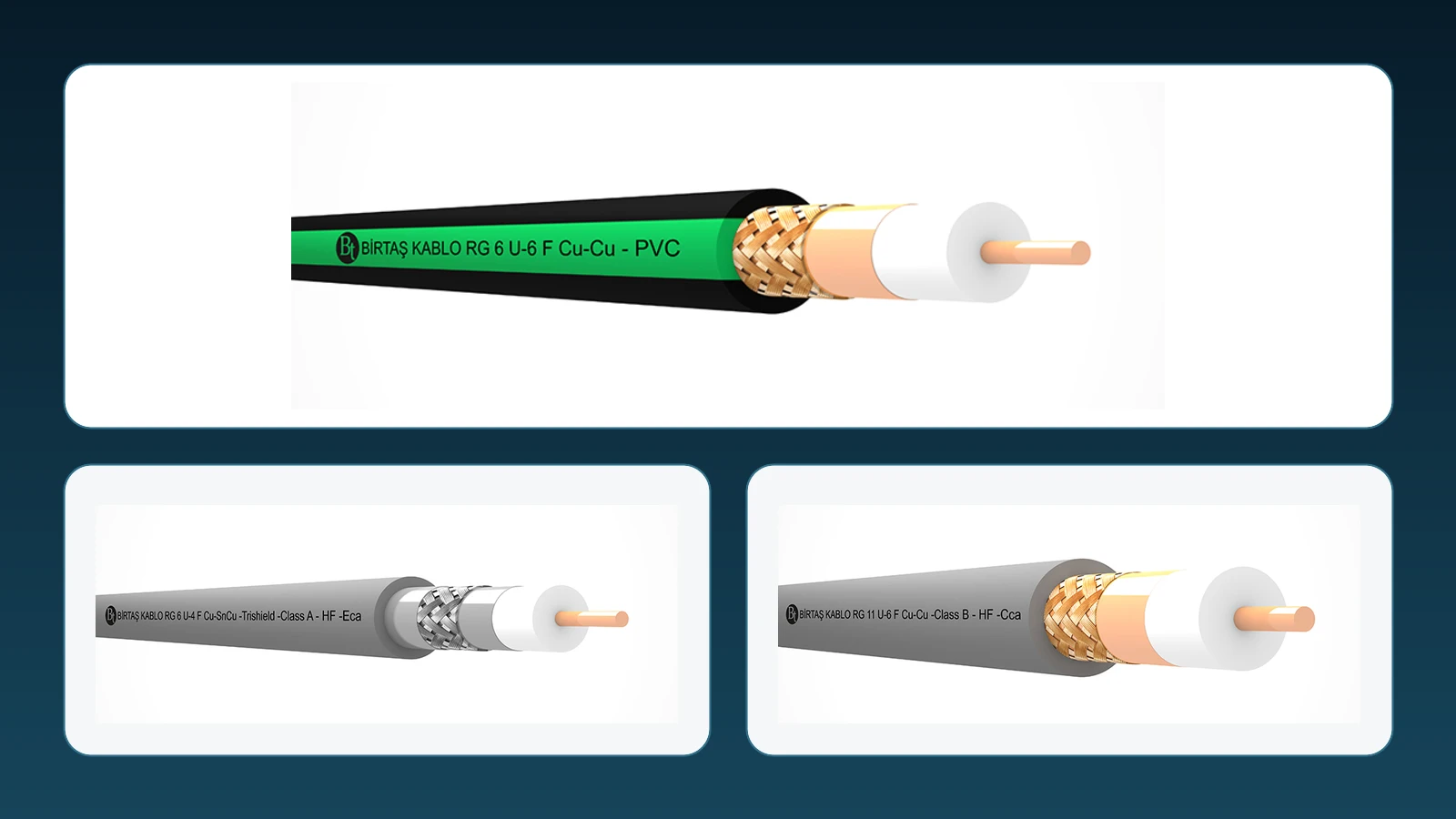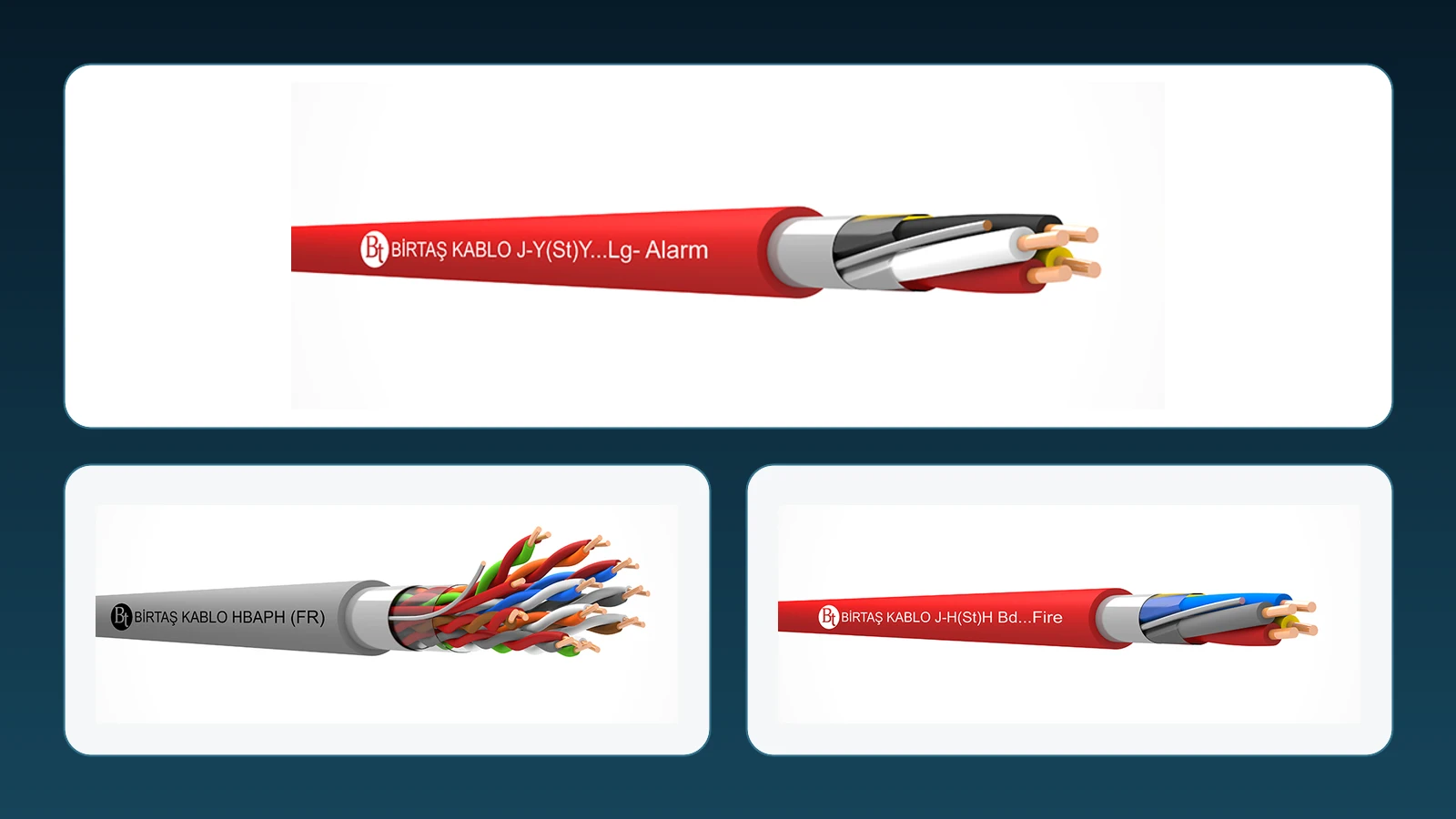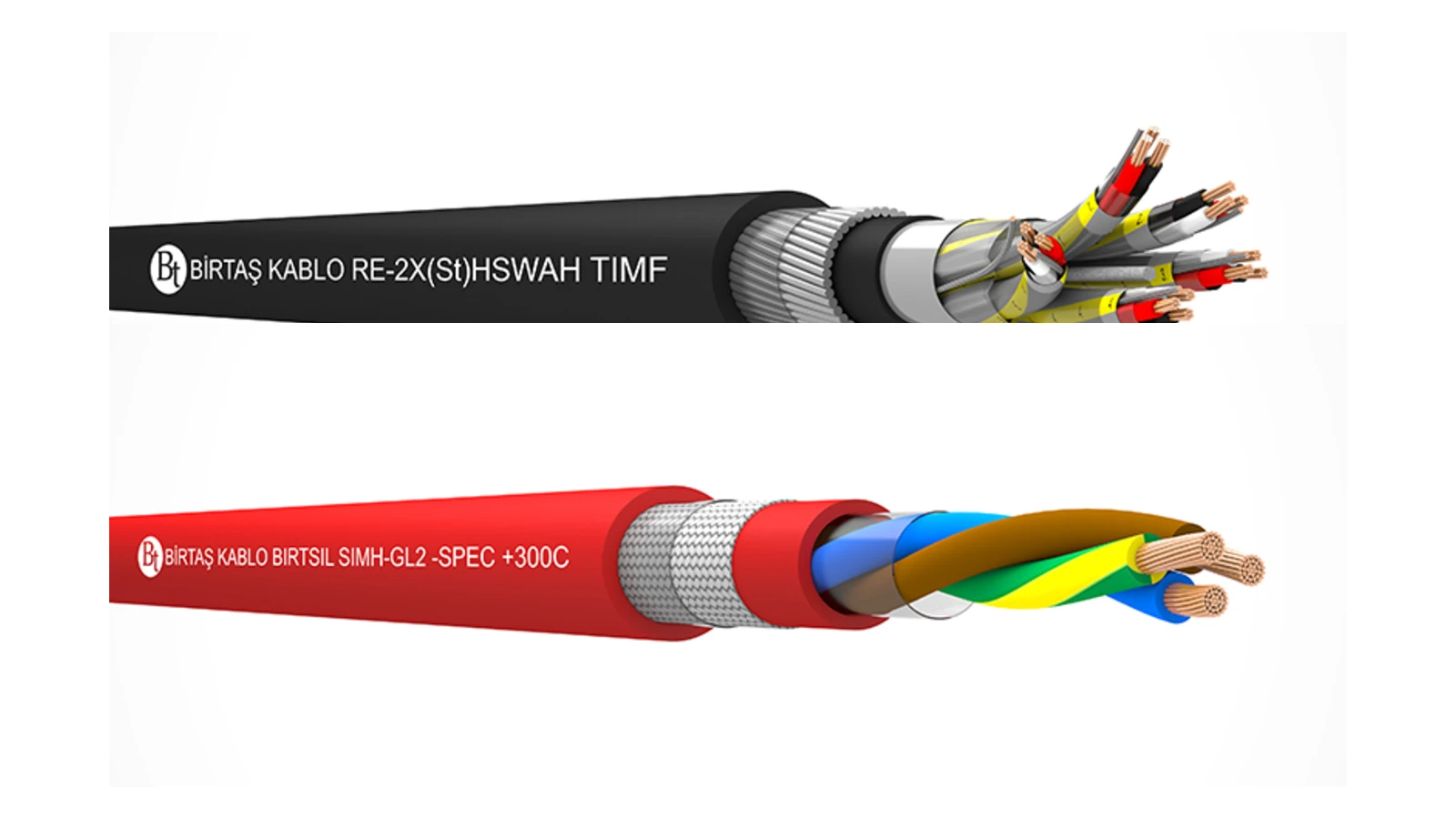






The selection of fire-resistant cables is not merely about specifying a product with an orange outer sheath. A cable’s behavior regarding flame propagation, the smoke and acidic gases it generates during combustion, its fire response classification as a building material, and its ability to maintain electrical functionality under the effects of fire are all important performance criteria. Birtas Kablo’s current range of fire-resistant products includes flexible data and signal cables, shielded versions, paired installation cables, options with woven or wire armor, as well as high-temperature-resistant silicone designs. It is essential to carefully review the test specifications, voltage ratings, temperature ranges, and intended applications for each individual product.
This guide helps to translate the information found on Birtaş Kablo’s official category, product, and data pages into practical project decisions. Designations such as FE180 or PH120 should not be interpreted solely based on the cable name; it is essential to verify the corresponding test standards and voltage specifications. Similarly, the CPR rating and the circuit’s integrity in the event of a fire cannot be used interchangeably. The final choice should be made by considering the specific functions of the project, the fire scenario, the cable routing, the installation system, and the current documentation related to the ordered product code.
Distinguish five different fire-related concepts
Flame retardancyIt relates to the behavior of a cable under a specified flame test. On many of Birtaş’ fire-resistant product pages, standards EN 60332-1-2 and IEC 60332-1-2 are listed; for some products, EN/IEC 60332-3-24 Category C is also specified. The flame propagation test for bunched cables is not within the same scope as the test for individual cables. Instead of merely stating “flame-retardant” in the technical specifications, the required tests should be clearly specified.
Smoke density and halogen-freeThese requirements are related to maintaining visibility and managing the risks posed by corrosive gases during a fire. For HFFR products such as LIHH FE180 and PH120, the official standards EN/IEC 61034-2 specify smoke density requirements, while EN/IEC 60754-1/-2 define halogen-free testing criteria. However, these tests alone do not guarantee that the cable will continue to conduct electricity in the event of a fire. Similarly, the designations “LSZH” or “HFFR” do not inherently indicate a specific Euroclass rating or the duration for which the circuit integrity will be maintained.
Circuit integrity, may be indicated on the manufacturer’s product pages by FE180 and references to IEC 60331-21 or IEC 60331-23. Performance under the effects of flame and mechanical impact Within the scope of EN 50200, products ranging from PH30 to PH120 are available in the time classes specified on the product label. These represent different testing procedures. The presence of the designations FE180 or PH120 in a product name should not be assumed to mean that all products with the same cross-section and order code will meet identical requirements under all circumstances; it is essential to check the scope and test voltage information provided on the data sheet.
CPR The Euroclass classification within the scope of EN 50575 addresses the fire response performance of the cable’s materials as well as the relevant certification process. The CPR logo or the reference to EN 50575 are not alternatives to the FE180 or PH rating. If a specific class is required, or if additional classifications such as those related to smoke, burning droplets, or acidity are needed, these must be verified through the performance declarations of the proposed product. The presence of a compliance logo on the official category illustration or in the PDF document is not sufficient to determine the class of a product code.
The LIHH family: flexible data and signal circuits
LIHH FE180 PH120 is described on Birtaş Kablo’s official website as a halogen-free, flame-retardant, fire-resistant data and signal cable. Its applications include instrumentation and control engineering, communication systems, automation, electronic data and signal transmission, as well as enclosed environments where low levels of smoke and corrosive gases are required. The product page explicitly states that this cable should not be used outdoors or directly buried in soil, but is intended for indoor applications only.
The product consists of Class 5 flexible bare copper conductors, halogen-free elastomer insulation, cores laid up at the appropriate pitch, glass fiber protective layers, and an HFFR outer sheath. According to official specifications, the operating voltage is 250 V for cross-sections below 0.50 mm² and 300/500 V for cross-sections 0.50 mm² and above. The recommended operating temperature range is −30°C to +80°C for fixed applications and −5°C to +50°C for flexible applications. The minimum bending radius is specified as 10 × D for fixed applications and 15 × D for flexible applications. These values apply specifically to this LIHH product and should not be applied to other types of fire-resistant cables.
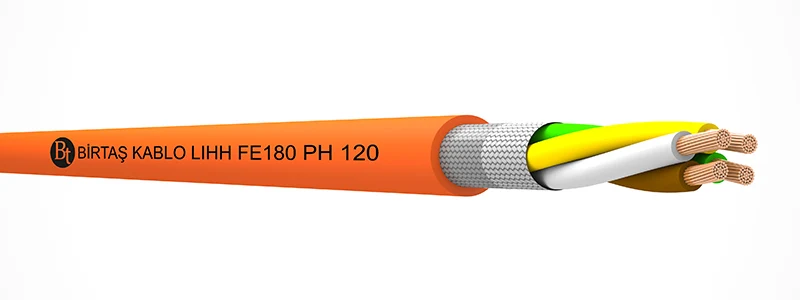
Shielding selection: assess the electromagnetic environment separately from fire performance
The fact that a fire-resistant cable maintains circuit integrity does not automatically ensure immunity to interference. In sensitive signal or control circuits, structures such as copper braid shielding (like LIHCH) or foil shielding (like LIH(St)H) may be required. The J-H or JE-H series of cables, which are stranded in pairs, offer different electrical properties for various installation and communication applications. The choice of conductor configuration, mutual capacitance, capacitance imbalance, and type of shielding is determined based on the specific signal requirements of the equipment in which they will be used.
The grounding method, terminalization equipment, and equipotential bonding scheme of the screen in the project must also be specified. A metallic screen and a steel wire mesh or wire armor do not serve the same purpose. A screen is selected to protect against electrical interference, while armor is primarily used to withstand mechanical impacts; both components may be included in the same product design. The connectors, junction boxes, and terminals used along the fire route must also match the actual external diameter, the type of screen or armor, and the prevailing environmental conditions.
Mechanical protection options for paired installation cables
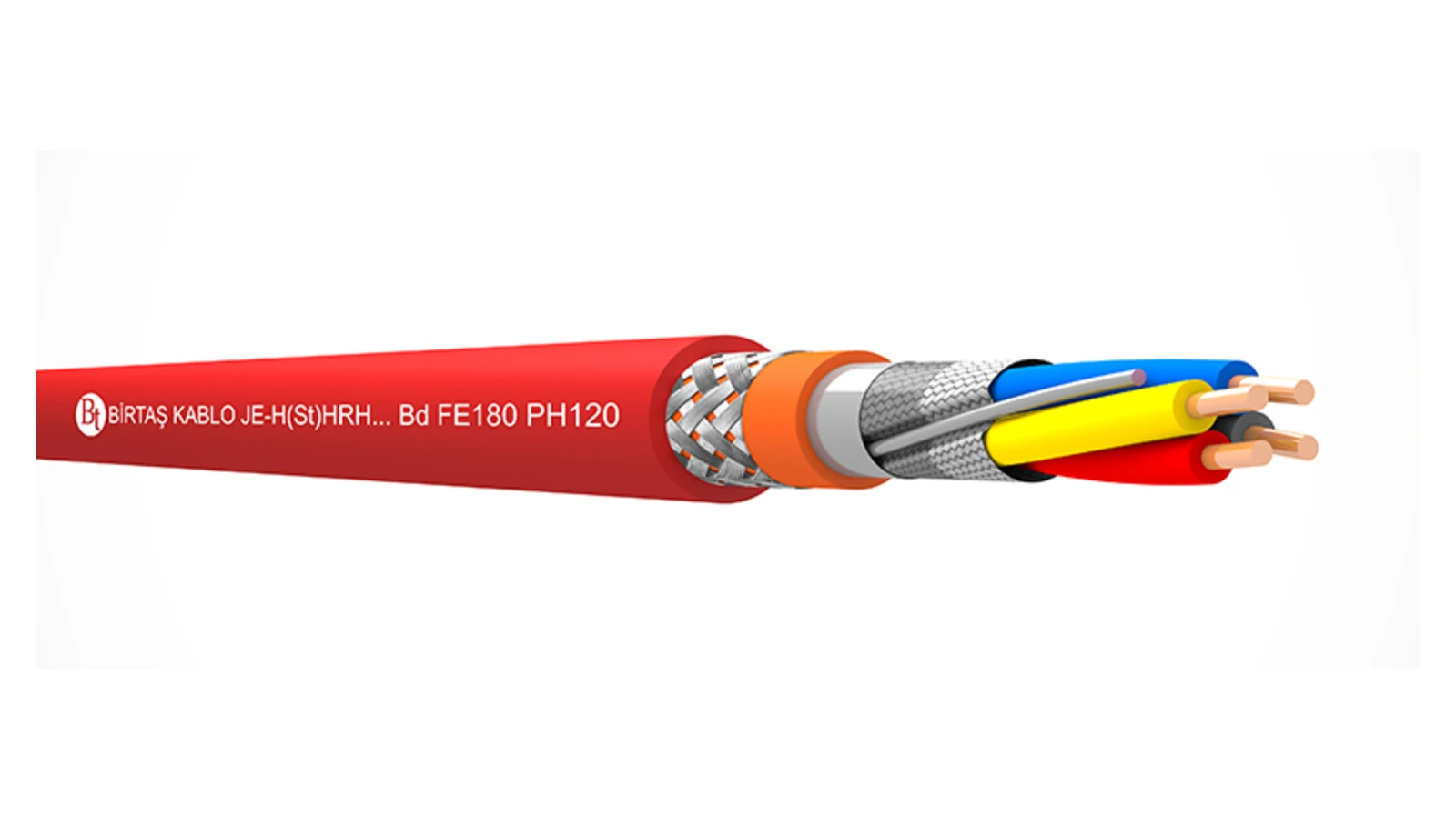
In the JE-H(St)H…Bd series, solid copper conductors are twisted in pairs; for multi-pair constructions, grouping and numbered tape labeling can be used. The common shielded design ensures the orderly transmission of electrical signals and communication data. The official product specifications refer to IEC 60331-23 for FE180 and EN 50200 for PH30–PH120 in terms of flame and mechanical impact resistance. In addition, test results regarding flame propagation, smoke density, and non-halogen content are listed in separate sections.
In the JE-H(St)HRH…Bd variant, a galvanized steel wire mesh layer is included. This layer serves to provide protection against mechanical stress and contribute to magnetic shielding. In another variant, a steel wire armor may be used instead. The presence of this mechanical layer does not necessarily mean that the cable is suitable for use in all environments or in direct contact with soil. It is essential to verify the product’s specifications regarding indoor/outdoor use, exposure to moisture, UV radiation, and burial conditions. Additionally, the pulling forces and bending requirements along the installation route must be within the limits permitted by the product.
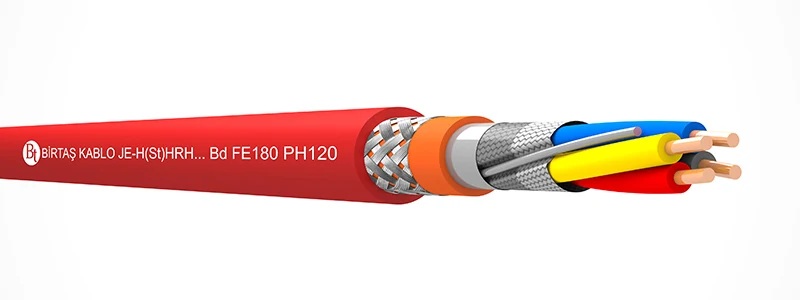
Distinguish high-temperature operation from operation during fire in the specification
BIRTSIL LISHCSH-PF FE180 PH120 is a silicone data cable that combines high and low-temperature resistance with circuit integrity even in fire conditions, all within the same specialized product structure. According to the official description, this cable features twisted conductor pairs, silicone insulation, glass fiber tape, a copper wire mesh shield, and a silicone outer sheath. It is designed for use in instrumentation, control, communication, and automation applications, and is suitable for both dry, humid, and wet environments in machinery, foundry, factory, and industrial facilities.
The technical specifications for this special product include a rated voltage of 300/500 V, as well as operating temperature ranges of −60°C to +180°C and −25°C to +180°C for fixed and flexible applications, respectively. The minimum bending radii are specified as 6 × D and 15 × D. For FE180, the IEC 60331-23 standard applies; for PH30–PH120, the EN 50200 standard is used. The temperature resistance of +180°C and the results of fire resistance tests are two separate specifications: the first refers to the normal/expected operating conditions, while the second pertains to the electrical performance under defined fire test conditions. These values cannot be generalized to all silicone cables with orange-colored sheaths.
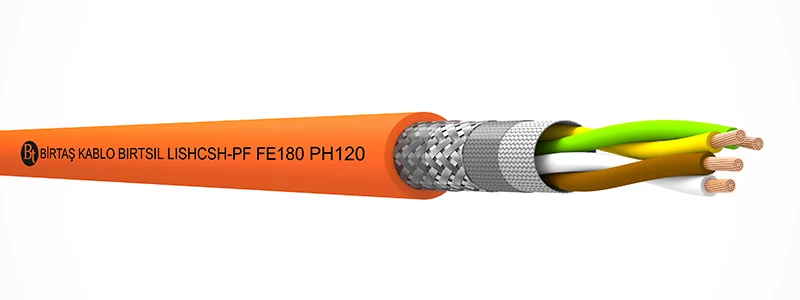
Define the circuit function as clearly as the cable type
Emergency announcements, fire detection systems, smoke control measures, emergency lighting, evacuation systems, as well as lines that serve to ensure the safe operation of pumps or processes, each perform distinct electrical functions. It is not appropriate to assign data and signal cables to power circuits, or to use utility cables for precise analog measurements—especially when those cables are merely labeled as “fire-resistant.” The operating voltage, conductor cross-section, current capacity, voltage drop, line impedance, and the connection specifications specified by the device manufacturer must all be carefully calculated based on the specific requirements of the circuit.
The continuity of the pair, core, and shield along the entire length of the line must be compatible with the terminal connections of the field equipment. In cases where multiple circuits run along the same path, electrical separation, shielding measures, and physical bundling methods must be carefully evaluated. The duration of operation expected in fire scenarios, as well as the level of mechanical impact, must be clearly specified in the specifications; only the relevant information regarding FE and PH performance from the product page should be requested.
Request CPR and circuit integrity documentation separately
If a project requires a specific CPR class in accordance with EN 50575, it is necessary to verify the performance data corresponding to the full product code of the proposed cable. In addition to the main class, additional classifications such as smoke, flaming droplets, and acidity may be specified; these must correspond exactly to the requirements stated in the specification. It is not advisable to attempt to determine the Euroclass classification of a cable based on its general category, sheath material, or color information on its product page.
If circuit integrity is required in the event of a fire, the relevant IEC 60331 reference, the definition of “FE”, the EN 50200 reference, and the scope of “PH” must be separately checked on the manufacturer’s data sheet. Depending on the product family, the test standard may refer to section “-21” or “-23”. The electrical voltage and mechanical impact requirements specified by the application must also be compared with the information provided in the documentation. Therefore, even if the CPR declaration and the FE/PH test results are located in the same folder, they cannot be used as evidence for each other.
| Project question | Product characteristic to examine | Assumption to avoid |
|---|---|---|
| Should cables be designed to limit the spread of flames? | EN/IEC 60332 tests listed on the product page | The assumption that the designation “HFFR” indicates compliance with all flame resistance testing requirements. |
| Is low smoke emission and non-halogen content required? | EN/IEC 61034-2 and EN/IEC 60754-1/-2 clauses | The assumption that low smoke emission implies the integrity of the electrical circuit. |
| Should the circuit still be functioning during a fire? | Product-specific IEC 60331 and, where required, EN 50200 FE/PH coverage | The assumption that the orange outer sheath alone guarantees a certain lifespan. |
| Are there any CPR classifications available for construction cables? | Performance data and Euroclass classification corresponding to the full product code. | The assumption that the CPR logo replaces FE180 or PH120. |
| Are sensitive signals going to be transmitted? | Pair/triad construction, capacitance, and individual or overall shielding | The assumption that all fire-resistant cables provide the same level of data performance |
| Is mechanical protection necessary? | Woven/wire armor, outer sheath, and operating environment | The assumption that the term “armored” implies permission for use in automatic outdoor environments and for direct burial. |
Match routing and installation decisions to product limits
The fire resistance testing of a cable does not imply that each installation along the line in the field will automatically maintain the same performance. Cable bends, clamps, carriers, as well as connection and termination points must be selected in accordance with the project specifications; the minimum bending radius of the material must be ensured. If the route in the field poses risks of exposure to hot surfaces, water, chemicals, UV radiation, or impact, the compatibility of the material with the cable sheath is inspected, regardless of the cable’s fire resistance properties.
The information on the LIHH product page regarding indoor use and restrictions on direct burial is a good example in this regard. Even if the same fire tests are listed, another armored product may have different application scenarios. Instead of drawing general conclusions based on the product family name in the catalog, it is essential to match the official “Application Areas,” “Cable Structure,” and “Technical Specifications” sections with the specific product details in the order form.
Checklist for quotation and acceptance documentation
- Describe its function: Which system is the cable used to power, and which signal does it transmit? How long can it continue performing its function in the event of a fire?
- Determine the electrical configuration: Define voltage, current, cross-section, core/pair/triad count, capacitance, and shielding requirements.
- Separate fire-related requirements: For the cable flame test, record the results for flame propagation, smoke generation, halogen emission, CPR, and circuit integrity in separate rows.
- Match the standard with the product. Check the applicable IEC 60331 part, EN 50200 PH coverage, and test voltage, if specified, in the full product data sheet.
- Classify the rotors: Indicate internal, external, underground, dry, humid, wet, chemical, UV, and mechanical stress conditions.
- Verify the installation. Plan the outer diameter, minimum bending radius, pulling capacity, type of conductor, cable glands, shielding/armoring treatments, and any additional methods required.
- Link the document to the order code: Verify that the data sheet, test report, or performance statement is applicable to the specified cross-section and design.
- Record the on-site acceptance: Include the reel and label information, product code, routing details, termination information, and document revisions in the commissioning documents.
Oskon approaches fire-resistant cables not as a single marketing concept, but rather as a combination of verified performance criteria. By matching the specific requirements of a circuit with the appropriate Birtas product configuration, separately verifying compliance with CPR standards, low smoke/halogen emissions requirements, and FE/PH specifications, and ensuring that the cable’s routing and termination are part of a well-designed system, a clear and verifiable solution is created. Product availability, document revisions, and custom cross-sectional options are also confirmed at the time of the offer.
Official technical resources
- Birtaş Kablo – Fire-resistant cables
- Birtaş Kablo – Product page for LIHH FE180 PH120 cables
- Birtaş Kablo – Product page for LIHCH FE180 and PH120 shielded cables
- Birtaş Kablo – Product page for JE-H(St)HRH…Bd FE180 PH120 cables
- Birtaş Kablo – Product page for BIRTSIL LISHCSH-PF FE180 PH120 silicone products
- Birtaş Kablo – Official product pages for LIHH FE180 and PH120
- Birtaş Kablo – JE-H(St)HRH…Bd FE180 PH120 official data sheet
Fire resistance performance, application scope, and electrical specifications may vary depending on the product family and cross-section. The CPR classification and circuit integrity information must be verified separately using the complete order code.