






Cycle imbalance
Even when the production line runs quickly, manual inspection, packaging or palletising can limit output and create intermediate stock.
We integrate robotic palletising, carton packing, packaging, labelling, vision inspection and conveyor flows around your target cycle time.
Explore the solution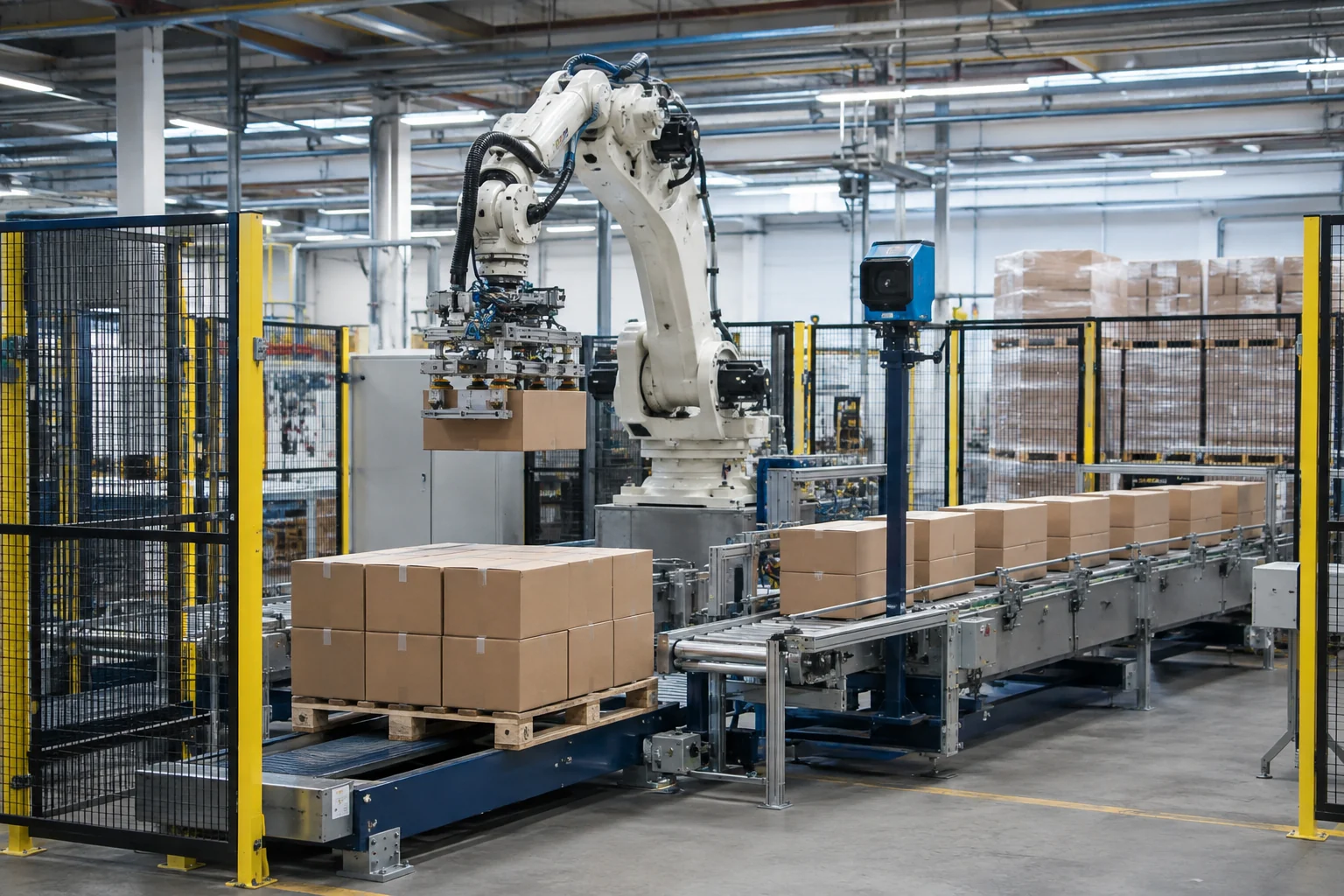
Even when the production line runs quickly, manual inspection, packaging or palletising can limit output and create intermediate stock.
When products, cartons or pallet patterns change, equipment must follow the same recipe and changeover sequence. Uncoordinated changes cause downtime and errors.
Repetitive lifting, incorrect labels, missing cartons and unsuitable pallet arrangements affect ergonomics, quality and delivery performance together.
The end-of-line cell manages product arrival, quality status, packaging format and the destination pallet within one recipe context. Each transfer starts when the next machine signals that it is ready, and completion is recorded.
Product type, direction, quality status and traceability information are checked.
→Carton forming, sealing, labelling and weight checks run in synchronisation.
→Apply the gripper, pallet pattern and layer sequence specified by the product recipe.
→The pallet is secured, its identity verified, and it is handed over to the delivery flow.
The scope is determined project-specifically based on product geometry, packaging type, cycle target, shift arrangement and acceptance criteria.
Product orientation, grouping, sequencing and precise transfer tasks use a gripper suited to the product.
Carton erecting, product placement, sealing and package verification follow a shared recipe.
Presence, orientation, surface, code, weight and dimensional checks support decisions without stopping the line.
Product, package and pallet IDs are matched to the production order; reading and printing results are recorded.
Pallet patterns, layer arrangements, interlayer sheets and end effectors are designed around the load characteristics.
Accumulation, infeed and outfeed transfers, safe access and controlled stops are addressed within one architecture.
Dimension, weight, surface area, deformation, direction and holdable areas are verified with real specimens.
The sustainable cycle is calculated with micro stops, format changes, and downstream waits.
Stability, layer sequence, carrying load and variable format needs are solved in the same mechanical design.
Access, stopping, manual recovery, maintenance and performance tests are defined in the acceptance plan.
The product family, packaging, pallet, shift and sustainable cycle goals are clarified.
Current cycle, waiting, change and error data are observed in the field.
Model the layout, robot reach, gripper, conveyor, buffer and safety boundaries.
Verify bottlenecks, collision limits, recipes and exception scenarios before production.
Assembly, commissioning, product testing and FAT/SAT acceptance criteria are completed.
Operator training, performance monitoring, spare parts and maintenance plan are handed over to the operation.
Managing package, box, shrink package and pallet flows with high repeatability.
Product validation, batch/lot tracking, sensitive packaging and controlled pallet preparation.
Grouping and palletizing of boxes, parts and delivery units according to the recipe.
Packaging, labeling and preparing for shipment of variable product formats.
Tell us briefly about your operation so we can establish the right next step together.
Discuss your requirements Your request is routed directly to the relevant engineering team.
Engineering confidence with Oskon.
Leave your details and our expert engineers will contact you for a preliminary consultation tailored to your needs.