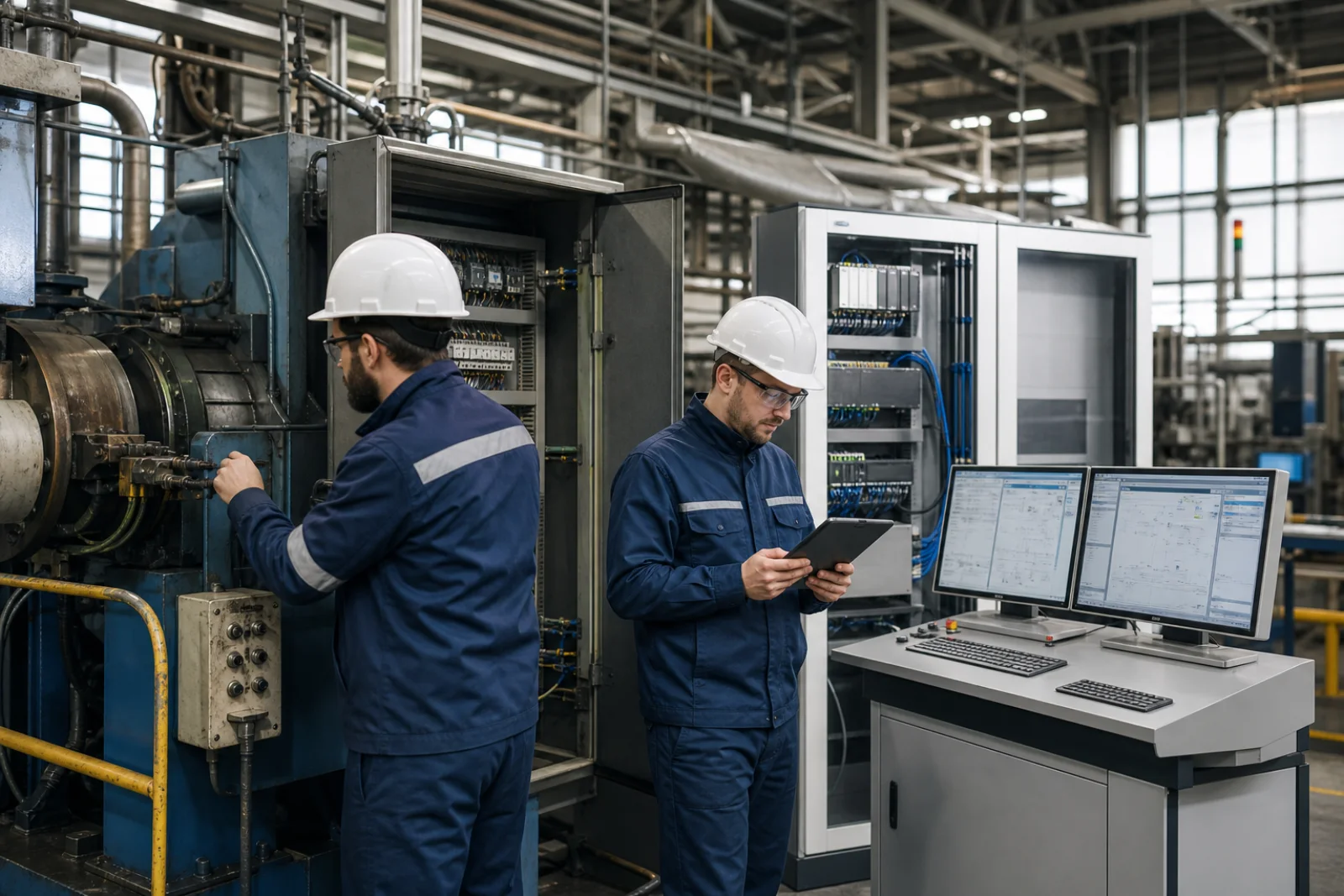







Learn the Fundamental Principles and Techniques of Machine Automation with PLC Programming and Build Successful Industrial Automation Projects.
PLC programming and machine automation have become indispensable to modern industry. As production lines demand greater efficiency, speed and precision, automation systems are increasingly capable of executing complex tasks. The PLC (Programmable Logic Controller) is one of the fundamental building blocks of industrial automation and is used to control a wide range of machines and processes.
The PLC originated in the 1960s and transformed industrial manufacturing by enabling the transition from manual processes and hard-wired relay control to digital automation. PLCs are now regarded as one of the most important components of machine automation.
Fundamental Principles of PLC Programming
PLC programming is the process of loading a logical sequence of instructions into a controller so that a machine can execute defined operations automatically. These programmes can be created using several programming languages. Common examples include:
- Ladder Logic (Ladder Diagram): A graphical language derived from the representation of electromechanical relay circuits and widely preferred by electrical engineers.
- FBD (Function Block Diagram): A graphical language that implements process control through interconnected function blocks.
- STL (Statement List): A textual language used to express more advanced logical operations.
Each programming language offers benefits for different application scenarios. In Ladder Logic, for example, an input signal from a sensor can trigger an output such as a motor. This is implemented using programming elements including logic operations, timers and counters.
Technical Foundations of Machine Automation
Sensors and actuators sit at the heart of machine automation. Sensors collect information from the operating environment and return it to the PLC. A photoelectric sensor, for example, detects the presence of a product on a conveyor and sends a signal to the controller. Actuators use the resulting control output to perform physical actions, such as a robotic arm packaging products.
An HMI (Human–Machine Interface) allows operators to interact with the automation system. HMI screens enable personnel to monitor production, check system status and intervene when required.
Industrial communication protocols such as Modbus, Profibus and EtherCAT also enable different automation components to exchange information reliably.
Implementation Techniques for Machine Automation with PLC Programming
When implementing a PLC-based machine-automation system, the following steps are critical:
- Define System Requirements: Determine the sensors, actuators and other equipment required by the automation project.
- Select the PLC Hardware: Choose the CPU capacity, input/output modules and supporting components.
- Develop the Programme: Create the control logic that the PLC will execute using the appropriate programming language.
- Test and Commission: Verify that the PLC programme operates correctly and commission the complete system.
A PLC-controlled packaging system provides a useful example. The controller detects products from signals received through sensors on the conveyor, then activates the actuators that execute the packaging operation.
PLC Programming Best Practices and Technical Guidance
Several practices and technical principles help create an effective and reliable PLC system:
- Modular Programming: Dividing the programme into small, manageable modules simplifies maintenance and troubleshooting.
- Documentation: Maintaining clear documentation is essential for future maintenance and updates.
- Frequent Testing and Simulation: Simulating the system before commissioning helps identify potential errors at an early stage.
Common problems include incorrect timer settings and improper configuration of input/output modules. Careful planning and systematic testing throughout development help prevent these errors.
The Future of PLCs and Machine Automation
Smart factories integrated with Industry 4.0 and the Internet of Things (IoT) will advance PLC programming further. Supported by machine learning and artificial intelligence, next-generation automation systems will optimise production processes and gain greater autonomy.
PLC programming will therefore remain a fundamental building block of future industrial systems. As industrial automation becomes more intelligent and data-driven, the role of PLCs will grow increasingly critical.
Machine Automation with PLC Programming
Machine automation with PLC programming is an essential technology for improving efficiency and accuracy in modern manufacturing. PLCs allow machines to execute complex tasks reliably and enable production processes to be automated.
Understanding the fundamentals of PLC programming is key to successful industrial automation projects for engineers and technical personnel. As the technology becomes more deeply integrated with Industry 4.0 and IoT, it will continue to transform industrial processes.