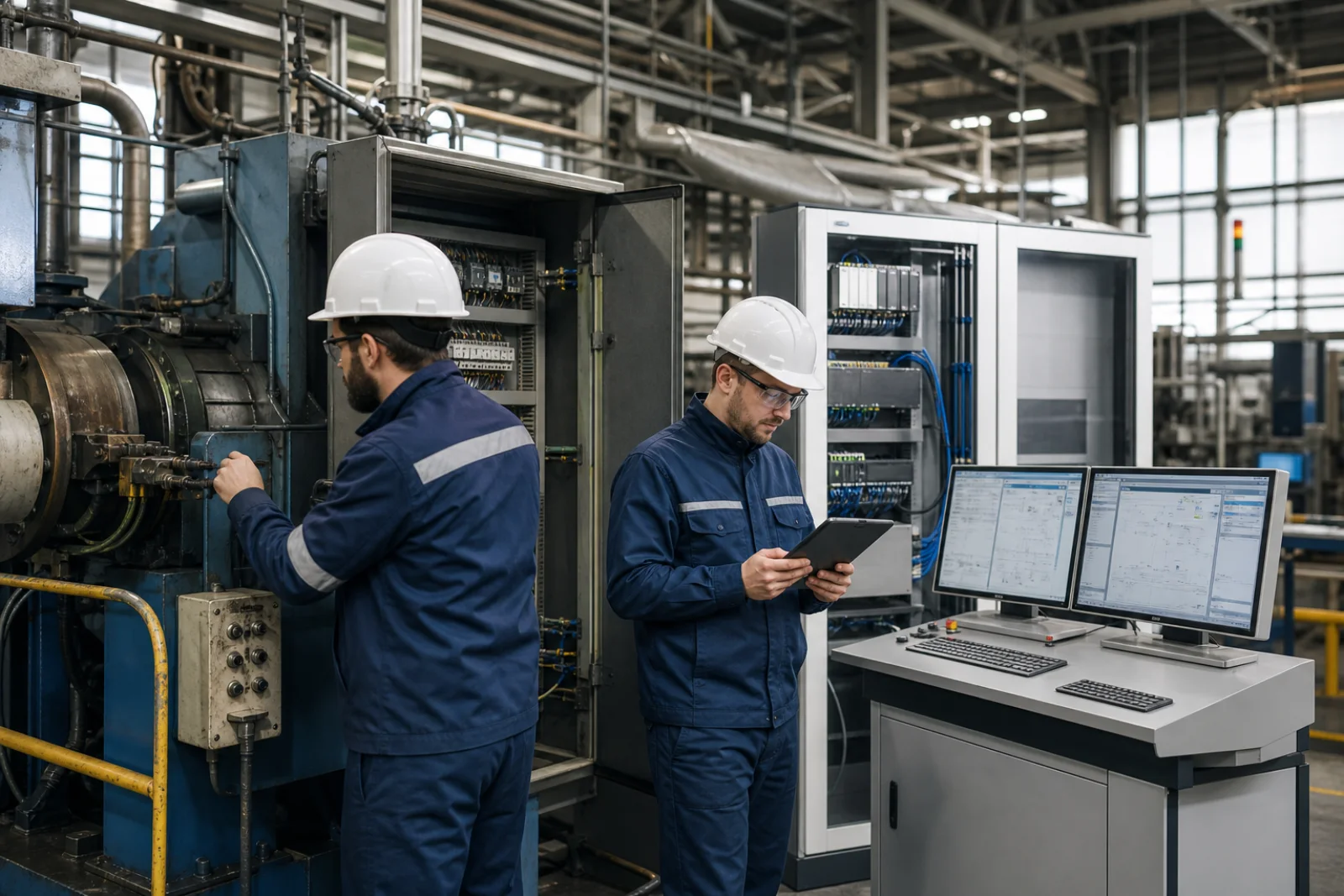







Industrial automation consulting for factories can reduce the strategic and implementation uncertainty associated with designing, deploying and maintaining plant automation systems and MES solutions. This enables manufacturers to realise operational efficiency gains and lower production costs sooner.
Automation consulting can support your organisation in a number of ways, including:
- Assessing existing manufacturing processes to identify areas where factory automation solutions can improve efficiency, reduce errors and increase productivity.
- Designing and implementing automation solutions—including programmable logic controllers (PLCs), human-machine interfaces (HMIs), and supervisory control and data acquisition (SCADA) systems—to automate repetitive tasks and improve overall system performance. Consultants can also support hardware and software selection and the development of purpose-built programs and controls.
- Developing a long-term strategy that supports your digital transformation roadmap and integrates automation technologies into operations.
- Providing guidance on best practices for managing and maintaining industrial automation systems.
- Navigating complex regulatory compliance requirements, reducing compliance risk and improving overall operations.
Automation consulting can be considered in two principal categories: factory or machine automation consulting and process automation consulting.
Machine automation is fundamentally the use of control equipment to perform manufacturing operations. It can be applied at every stage of production, including machining, inspection, testing, assembly, packaging and final delivery. Factory or machine automation has two main forms: machine or process automation and complete factory automation.
Process Automation can be defined as the use of control equipment to perform manufacturing operations on individual parts, subassemblies or product batches. The objective is to increase production speed or quality by minimising labour requirements or by raising machine speed and capacity with the same labour input.
Complete Factory Automation involves the use of programmable logic controllers, computers and other control equipment to sequence or operate entire production lines automatically. Its objective is to accelerate the full production process—from order entry to final delivery—with minimal manual intervention.
Differences Between Factory Automation and Process Automation
Factory automation, for example, can be categorised further into fixed, programmable and flexible automation.
Fixed automation is relatively rigid in terms of the cells and operations it can handle. A fixed production cell or line cannot be changed easily without significant cost and disruption to the facility.
Programmable automation allows rapid changes to product types, part numbers or production quantities within a single cell. The type or quantity of product to be manufactured is generally determined by programming computer systems directly connected to the cell controls.
Flexible automation enables rapid changes to product types, part numbers or production quantities within one cell with minimal cost and plant disruption. The product type or quantity can be changed through an ergonomically designed MMI (Man–Machine Interface) that is also connected directly to the cell controllers.
At its core, factory automation is a holistic industrial approach that increases automation across tasks and production processes within a facility, reducing the risks and harm associated with manual work. Process automation focuses on automating industrial control applications used to operate factories, plants and other industrial facilities.
Similarities Between Factory Automation and Process Automation
Factory automation is essentially process automation applied on a larger scale, although the two still share many characteristics. In both factory and process automation, changes to products or processes are often made by human operators rather than by the automated equipment itself. While process automation may be applied to a cell or group of cells within a factory, factory automation is used to automate the entire production line from order entry through to final delivery.
Process Automation can be used at every production stage, including machining, inspection, testing and assembly, whereas factory automation is most commonly used to assemble finished products from individual components.
Process Automation is widely used in discrete or batch-type operations in which products are manufactured individually. Factory automation involves production lines that handle continuous material flows and assemble products without human intervention between operations.
How Do Factory Automation and Process Automation Affect Quality?
Quality concerns in process automation commonly include the loss of line synchronisation between the product being assembled, the equipment performing the assembly operations, and the input/output devices supplying part or material data for processing.
In factory automation, quality concerns generally involve maintaining synchronisation across the entire production line. This requires close coordination between machines performing different process steps and the input/output devices that provide part or material data.
One of the principal benefits of factory automation is improved process quality, because machines can deliver superior accuracy, repeatability and speed. Its greatest challenge is also related to quality: compared with a simple process line, a fully automated factory contains many more components that can potentially fail or fall out of sequence.
Several factors should be considered before choosing between factory automation and process automation. In general, process automation may be the appropriate route when a high degree of flexibility is required and skilled operators are available to perform setups and minor adjustments. If greater accuracy or multi-shift operation is required, factory automation may provide a simpler and more practical solution. When the choice is uncertain, working with an experienced automation consultant or specialist is usually the most effective way to reach the right decision.