






Industry places diverse demands on modern automation systems, with the expectation that the required operation will always be delivered at the optimum price-to-performance ratio.
AS-Interface, or AS-i for short, provides precisely this. The objective was not to develop a universal fieldbus for every automation level, but to create an economically viable field-level system that connects binary sensors and actuators simply, reliably and cost-effectively, while linking them to a higher control level.
Traditionally, sensors and actuators were connected to PLCs or other controllers using individual cables and extensive wiring. The introduction of the actuator-sensor interface—also known as AS-Interface or AS-i—in the 1990s offered users and integrators a reliable, cost-effective alternative to cumbersome and time-consuming parallel wiring.
A freely selectable network topology makes an AS-Interface network easier to install and configure. The susceptibility of other systems to wiring errors often causes delays during installation. Reducing potential sources of error was therefore one of the highest priorities when AS-Interface was designed. Reverse-polarity protection through the use of an asymmetrical flat cable is just one of the measures adopted.
AS-Interface is a master-slave bus in which one master controls up to 62 stations or slaves. It operates at the lowest level of the fieldbus hierarchy, but when implemented with an AS-i master/gateway—sometimes referred to simply as an AS-i gateway—it can connect to higher-level networks such as DeviceNet, EtherNet/IP and PROFIBUS.
AS-i masters are also available for applications that do not require gateway functionality. They connect readily to higher-level control platforms such as PLCs, PC-based control systems and DCS (distributed control systems).
AS-Interface also provides safety functionality known as “AS-i Safety at Work”. With the addition of a safety monitor, the AS-i network can manage safety devices such as emergency stops, light curtains and gate interlocks in compliance with SIL3/PLe safety standards.
The principal benefits of AS-Interface are simplicity, low cost and high speed. When extended addressing is used, one master can control up to 62 AS-i slaves. Each slave can provide eight inputs and eight outputs, giving a total capacity of 496 inputs and 496 outputs. With standard addressing and 31 connected units, the maximum response time is 5 ms per I/O point; with extended addressing, the maximum response time is 20 ms per I/O point when eight I/Os are used per slave. AS-i is also inherently deterministic and repeatable, making response times dependable.
Although AS-Interface was originally developed by a group of 11 companies manufacturing sensors, actuators and control systems, it is a vendor-independent open standard supported by IEC 62026-2 and the AS-Interface Association.
Simple and safe—piercing technology
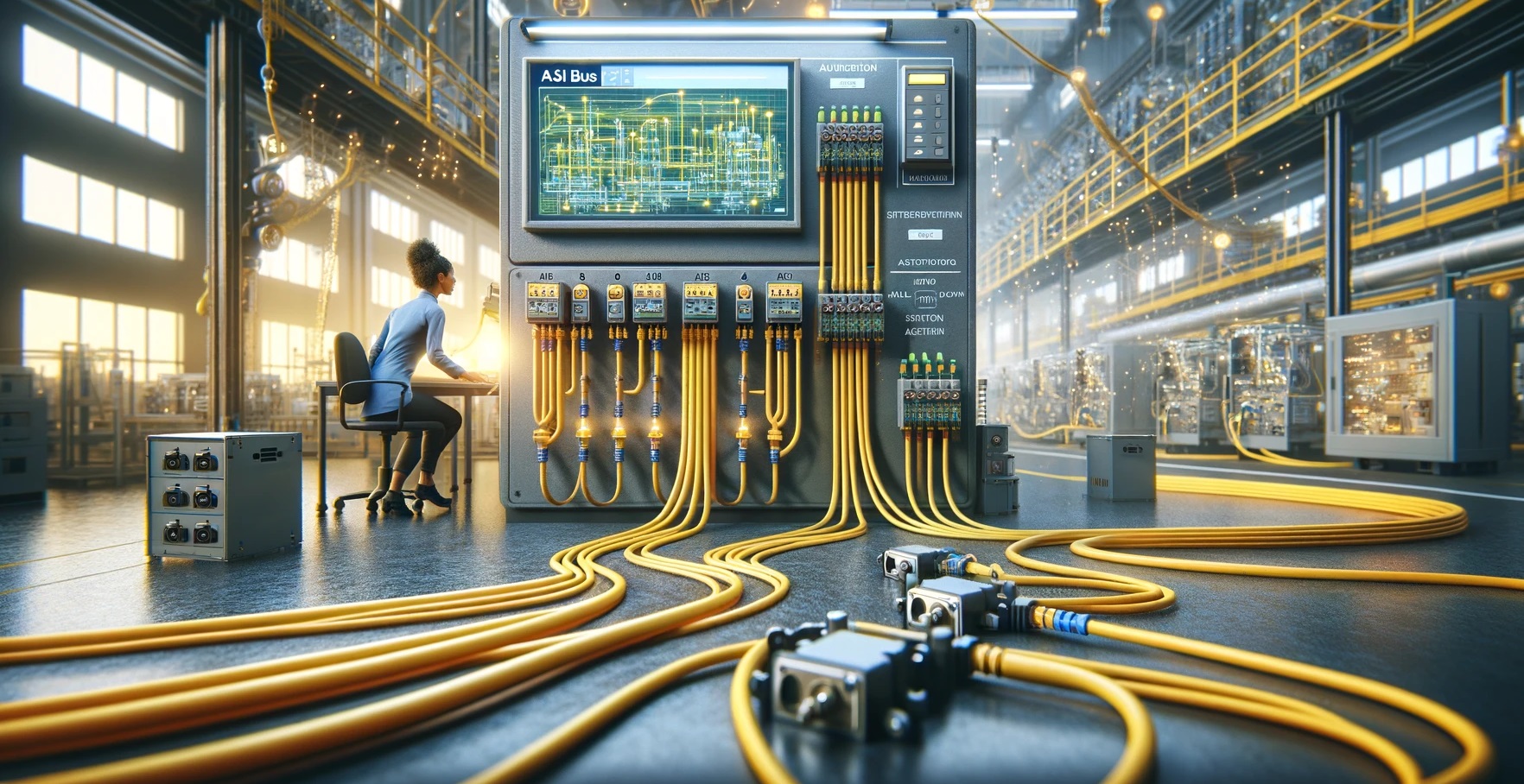
The straightforward installation of AS-Interface is made possible by its special connection method, known as piercing technology or, less commonly, Click-and-Go technology. It is based on the characteristic yellow flat cable, a mechanically reverse-polarity-protected two-conductor cable. During installation, the device's piercing pins penetrate the cable conductors to establish a secure electrical connection. Even if ease of installation were its only purpose, this technology would still offer numerous advantages:
- Direct and simple connection of sensors, actuators or modules
- Reverse-polarity protection
- Data and power in one cable
- Piercing technology
- The simplest connection technology
- Secure connection
- IP67
- No need to cut or strip cables
- Can be installed at any position
- Some cable types provide a “self-healing” capability, enabling trouble-free removal and reconnection
AS-i system data:
- Polling principle
- No structural topology restrictions
- Data and power over one two-conductor cable
- Noise-resistant
- Medium: unshielded cable, 2 × 1.5 mm²
- Signals, data and power up to 8 A
- Typically four inputs and four outputs per device; combinations of one to 16 inputs and outputs are possible
- IP67 enclosure protection for demanding industrial use
- Piercing technology
- Segment length is 100 m; segments can be combined into networks of up to 300 m using repeaters. Termination can extend a segment, and several termination-resistor solutions are available on the market
- Highly effective communication-error detection and prevention
- Simple commissioning
- Electronic address configuration through the bus connection
- Complete backward compatibility
AS-i advantages:
- Cost-effective wiring concept for the lowest field level in demanding industrial environments
- Connection to all common fieldbus systems through gateways, links or network couplers
- Freely selectable network topology
- Simple, economical installation and low connection costs
- Virtually error-free installation through the asymmetrical flat AS-Interface cable
- More enclosure space by eliminating conventional cable trees
- Easy configuration
- Simple diagnostics
- Modular design