





A conveyor system may look like a simple mechanism that moves a load from point A to point B. In reality, it is a critical automation component that brings product characteristics, flow rate, accumulation requirements, building constraints, operator interaction and upstream-system decisions together on the same physical line. An incorrect selection can cause product jams, damage, noise, excessive energy consumption, difficult maintenance and bottlenecks that stop the entire line.
Selecting the right conveyor begins with understanding the handling task before asking, “belt or roller?” What is the product, at what speed and in which direction will it travel, where will it stop, how will it change direction, will an operator handle it, and how should the flow continue after a fault? This guide systematically examines the criteria that should be evaluated when preparing a technical specification for warehouse and manufacturing applications.
Define the product to be conveyed in technical terms
Knowing only the maximum product weight is not enough. Record the minimum and maximum length, width, height, weight distribution, base surface, rigidity, friction, temperature and leakage risk. A corrugated carton, plastic tote, sack, tray, pallet and unpackaged product will behave differently on the same conveyor. The product base must be rigid enough to bridge the gap between rollers.
If the product family is broad, use boundary samples in physical tests: the smallest, largest, lightest and heaviest products, as well as those with the most deformed base or least stable centre of gravity. A design that works for the average product may fail with a small but operationally significant part of the actual product mix. Packaging deformation over time, taped surfaces and protruding components must also be considered.
Calculate flow and capacity requirements
Capacity may be specified in products, cartons or pallets per hour, or in tonnes per hour. Instead of dividing the daily total by operating hours, use the hourly peak profile. Product spacing, conveyor speed and product length determine capacity. As speed increases, so do the requirements for motors, controls, noise management and safe transfers.
Will the line only transport products, or must it also buffer them? If upstream flow must continue during a short downstream-machine stoppage, accumulation capacity is required. Multiplying the necessary buffer duration by the infeed rate gives an approximate product count; this is converted into physical conveyor length using product dimensions. In intralogistics design, excessive buffering consumes valuable space, while inadequate buffering propagates micro-stoppages across the entire line.
When is a roller conveyor suitable?
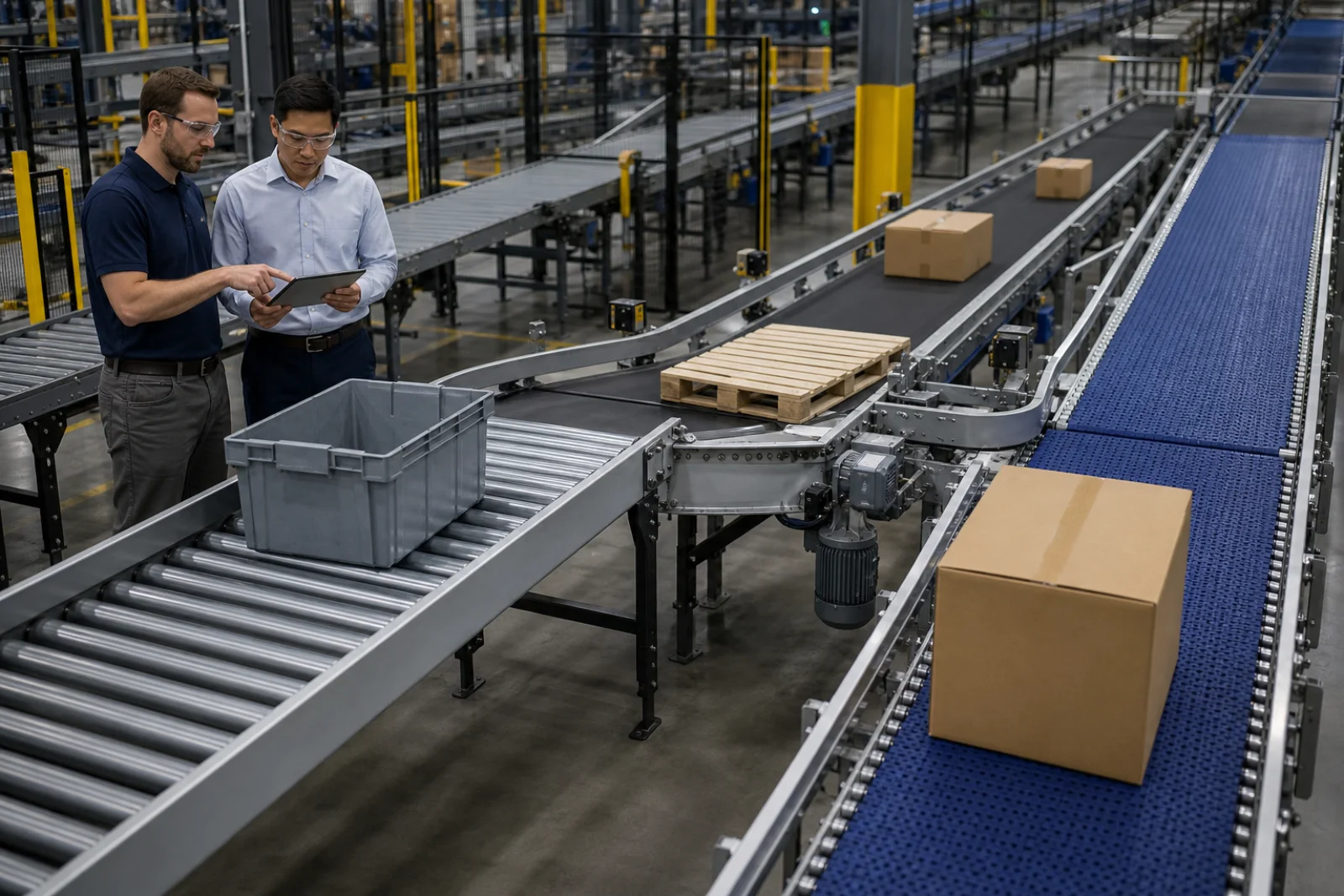
Roller conveyors are widely used for cartons, totes, crates and pallets with flat, rigid bases. Gravity rollers can operate through gravity or manual pushing, while powered rollers provide controlled transport and zoned accumulation. Motor-driven roller solutions that consume energy only in occupied zones are particularly advantageous in variable-flow applications.
Roller pitch is a critical design parameter. A sufficient number of rollers must support the product at all times; as a general rule, at least three contact points are targeted, although the final design requires an engineering calculation based on load and base flexibility. Small cartons, flexible bags and crates with feet may become trapped between rollers. If the gap at a transfer point is too large, the leading edge of the product may tip downward.
When should a belt conveyor be selected?
A belt conveyor provides continuous support for products with irregular bases and for small, flexible or otherwise unsuitable products for roller transport. It is used for cartons, parcels, components and sacks, as well as inclined transport and sensitive transfers. Belt-surface properties are selected according to friction, hygiene, temperature and cleanability requirements. Excessive friction can make transfers difficult, while insufficient friction can cause products to slip on an incline.
Belt tracking, tensioning and access to pulleys are important for maintainability. Where product leakage or dust is present, under-belt cleaning and scraper design must be considered. In food or pharmaceutical environments, material compliance, open-profile construction, washdown capability and drainage requirements differ significantly from standard warehouse applications.
Modular belt, chain and pallet conveyors
Modular plastic belts can provide advantages such as curved routing, drainage, washdown and local replacement of damaged sections. Materials in contact with the product must be verified for temperature and chemical resistance. Chain conveyors are used for pallets, heavy carriers and dedicated fixtures; the runners beneath the load must align correctly with the chain tracks.
A pallet-conveyor system may combine rollers, chains, turntables, lift-and-transfer modules and centring units. Pallet quality directly affects system performance. Broken boards, hanging stretch wrap, overhanging loads and non-standard feet can create sensor errors or jams. A pallet inspection station may be required at the infeed.
Inclined and vertical transport
To prevent a product from slipping or tipping on an inclined belt conveyor, its centre of gravity, base friction, acceleration and conveyor angle must be evaluated together. Cleated belts or sidewalls may be used. During downward travel, regenerative motor behaviour and braking safety must be considered. Inclined roller conveyors present a risk of uncontrolled acceleration.
For material flow between floors, a spiral conveyor, continuous vertical conveyor or lift may be selected. A lift operates intermittently and requires infeed and outfeed buffers; continuous solutions provide higher capacity but differ in footprint and investment cost. Fire-zone penetrations, doors and escape routes must be coordinated with the building design.
Transfer points are the most sensitive parts of the system
Points where conveyors merge, change direction or transition between different elevations present the highest risk of product jams. The gap between roller and belt sections, speed differences and transitions between side guides can cause a product to rotate or tip. Small products may require a nose bar, close-pitch rollers or a dedicated transfer plate.
A pusher, pop-up roller, chain transfer or turntable may be used for a 90-degree transfer. The choice depends on capacity, product sensitivity, orientation requirements and maintenance needs. If the barcode orientation must be preserved, the required turning behaviour must be stated explicitly in the technical specification.
Accumulation: contact or zero pressure?
With contact accumulation, products rest against one another. This approach can be simple and economical, but it may create problems with crushable cartons, mixed product weights or sensitive goods. In zero-pressure accumulation, the line is divided into zones and each product waits with a controlled gap. Although sensors, motor-driven rollers and control logic increase cost, they reduce product damage and startup load.
The required zone length is selected according to the largest product and the necessary safety gap. An excessively long zone reduces capacity, while a zone that is too short may allow a product to occupy two zones simultaneously. Products can be released individually or in slug mode, controlled according to the acceptance rhythm of the downstream machine.
Layout and building constraints
Columns, doors, forklift routes, pedestrian crossings, fire equipment, sprinklers, ceiling height and maintenance corridors constrain the layout. Routing the conveyor through every available space increases both cost and the number of transfer points. The shortest route is not always the best route; safe access and operational flexibility must be preserved.
Floor load capacity, anchoring zones and elevation differences must be verified through an on-site survey. Suspended conveyors may require structural-steel and seismic calculations. Where a bridge or gated crossing is provided over a forklift route, both safety and emergency-egress scenarios must be resolved.
Ergonomics and operator interaction
At picking, packing or quality-control stations, conveyor height, reach distance, product weight and repetition rate determine ergonomics. If the operator must constantly bend, stretch or rotate the product, automation creates a new risk instead of making the work easier. Adjustable stations may be considered for employees of different heights.
Station speed must be designed around a sustainable human work rate. Short-duration maximum performance cannot be used as a shift target. Material replenishment, empty-container handling and waste flow must receive as much attention as the primary product. Emergency stops and restart actions must provide clear feedback that operators can understand.
Machine safety
Risks involving trapping, crushing, cutting, falling loads, unintended movement and hazardous energy during maintenance must be assessed. Guards, fencing, interlocked doors, light curtains, emergency stops and safe torque off functions are selected according to the risk level. Emergency-stop devices must be accessible from every relevant point but should not be used as a normal operational stopping method.
Lockout/tagout points, stored mechanical energy and gravity-related hazards must be defined for maintenance. The required behaviour of other sections when one zone stops must be specified zone by zone. Safety functions must not only be designed; they must also be measured, validated and documented.
Sensor and identification technology
Photoelectric-sensor selection depends on product colour, reflectivity, shape, background and ambient light. Transparent or black products can be difficult to detect with a standard sensor. The sensor must observe the product’s most reliable surface, be protected from mechanical impact and remain accessible for cleaning in dirty environments.
Barcode readers, cameras, RFID, weighing and dimensioning systems must be selected according to conveyor speed and product spacing. The control logic must define where a product is routed after a failed read. A material tracking system must connect physical movement and its digital record through the same event.
Control architecture and integration
A small standalone line can be managed by a single PLC; in a larger system, zone control, remote I/O and distributed drives offer maintenance advantages. Handshaking between conveyors, product tracking, jam detection, restart and controlled line clearance should be implemented through standard function blocks. After a power interruption, the system must recover without losing product tracking.
The WMS manages work orders, the WCS makes flow decisions, and the PLC controls real-time movement. Product identity, source, destination, status, fault and timestamp must be defined explicitly in the interface. Buffering or safe-stop behaviour must be specified for a communication failure, and system clocks must be synchronised.
Energy efficiency and noise
Long conveyors operating continuously can consume significant energy. Putting unoccupied zones into sleep mode, using high-efficiency motors and drives, reducing mechanical friction and avoiding unnecessary line speed deliver savings. The control strategy must balance frequent start-stop cycles against motor life.
Rollers, chains, gearboxes and product contact generate noise. For lines close to work areas, low-noise rollers, appropriate speed, vibration isolation and a defined maintenance standard are important. Noise is an occupational-health issue as well as a matter of comfort, so measurable criteria may be included in site acceptance testing.
Maintainability and spare parts
If motors, sensors, belt tensioners, bearings and control enclosures are inaccessible, a short fault turns into extended downtime. Guards must be removable safely and quickly, and lifting points must be provided for heavy components. Replacement times for critical components should be reviewed during the design phase.
Standardising motor, roller, sensor and drive families reduces spare-parts inventory. However, an unsuitable component should not be selected merely to maintain standardisation. For components with long lead times, local stock, a recommended spare-parts list and preventive-maintenance intervals should be provided at handover.
Total cost of ownership
Comparing quotations solely by price per metre is misleading. Mechanical equipment, controls, installation, structural steel, electrical work, safety, integration, testing and training must be evaluated within the same scope. Future energy, maintenance labour, spare parts, belt or roller replacement, licensing and unplanned-downtime costs must also be calculated.
A system with a lower initial price but frequent maintenance requirements may be more expensive over its lifecycle. Modularity, ease of expansion and component availability also have economic value. An automation feasibility study should compare technical alternatives using total cost of ownership.
FAT and SAT acceptance criteria
During FAT, mechanical dimensions, panels, software, safety logic and representative product transfers are verified. SAT covers alignment, sensors, direction, capacity, accumulation, jam recovery, power interruption and upstream-system connectivity under actual site conditions. Test products must represent the real product mix.
In addition to products per hour, capacity criteria should specify test duration, product spacing, error rate, availability and operator count. Damage criteria must be visual and measurable; where noise, energy or hygiene is critical, these must also be included in the acceptance plan.
Conveyor selection checklist
- Have the dimensions, weights, base characteristics and environmental conditions of the entire product family been verified?
- Have hourly peak capacity and the required buffer duration been measured?
- Have transfer points been tested using the smallest and most challenging product?
- Does the layout preserve maintenance, pedestrian, forklift and fire-safety access?
- Have ergonomics and machine-safety risk assessments been completed?
- Are the PLC, WCS/WMS and post-fault recovery scenarios defined?
- Are energy, noise, maintenance and spare parts included in the lifecycle calculation?
- Are FAT and SAT criteria measurable against the actual product mix?
Conclusion
The right conveyor system transports products without damage, sustains the target capacity, interacts safely with people and recovers quickly after a fault. The technology type is the outcome of the product and task requirements, not a predetermined preference. A decision should not be based solely on an equipment catalogue without measurement, an on-site survey and end-to-end flow analysis.
For a project in which conveyors, mobile robots, sorters and automated storage components operate through a common control architecture, explore our intralogistics solution families and contact our team for product testing and capacity analysis.
Frequently asked questions
Is a belt or roller conveyor better?
Neither is universally superior. Rollers are generally more suitable for cartons and totes with flat, rigid bases; belts provide continuous support for small, flexible products or those with irregular bases. Capacity, accumulation and environmental conditions complete the decision.
How is conveyor speed determined?
It is calculated using hourly peak volume, product length, required spacing, transfer capability and the rhythm of the downstream process. Excessive speed creates noise, damage and control complexity.
How much conveyor buffering is required?
Multiply the downstream-process stoppage duration to be tolerated by the infeed rate to determine the product count. Convert this into physical length using product dimensions and the zone structure, then validate variable flow through simulation.