





Discover industrial robots, AMRs and AGVs, and learn how automation connects warehouse operations with production and material flow.
Industrial robots and robotic automation
An industrial robot is a programmable, multi-axis manipulator that replaces people in repetitive, heavy or hazardous tasks. Articulated robots offer a broad working envelope and flexible reach; SCARA robots provide a speed advantage in planar assembly work; delta robots are used for lightweight pick-and-place applications requiring high cycle rates; and Cartesian systems are preferred for long-axis linear movement.
Common applications of robotic automation include welding, palletising, pick and place, machine tending, bonding, painting and inspection. For heavy-load handling and stockyard operations, unmanned crane applications are used. Consistent seam quality in robotic welding and an unchanged cycle time throughout the shift in palletising are among the most visible benefits.
Collaborative robots are designed to work in the same area as people without conventional fences and barriers. However, “collaborative” describes the application, not the robot itself: if the end effector carries a sharp component, the application is no longer collaborative. Every robot cell must therefore undergo a risk assessment together with its gripper and the component it handles.
The success of a robot cell depends more on gripper design, component feeding and cycle planning than on the robot brand. The robot itself is often the most predictable component; the uncertainty lies in how the part arrives and how it is held.
Autonomous mobile robots, AGVs and intralogistics
An autonomous mobile robot, or AMR, is a transport vehicle that perceives its environment and calculates its own route. An automated guided vehicle, or AGV, follows a defined line or reference points on the floor. The difference is flexibility: an AGV operates predictably on a fixed route, whereas an AMR can change its path when it encounters an obstacle and does not require a new line when the layout changes.
Intralogistics covers the entire flow of material within a facility. Every transport step, from receiving raw materials and feeding production lines to moving finished goods to dispatch, falls within this scope. Material flow is an invisible cost in many facilities: operator walking time, space occupied by work-in-progress and stoppages caused by material delivered to the wrong location become apparent only when they are measured.
Mobile robot families vary according to the requirement. Latent mobile robots (LMR) that travel under and lift racks are used for warehouse picking; forklift mobile robots (FMR) handle palletised loads; carton transfer units (CTU) transport boxes; and the CMR family supports heavy-duty and conveyor-based transport. Fleet management software coordinates these vehicles, handling task allocation, traffic management, charging plans and priority rules.
Infrastructure is the issue most frequently overlooked in mobile robot projects. Floor flatness, door widths, lift and automatic-door integration, wireless network coverage and charging-point locations may be more decisive than robot selection. Measurements taken during the feasibility study prevent many commissioning surprises. See our accessories and field equipment for charging, navigation and field hardware.
Warehouse automation: conveyors, sorters and vertical storage
Warehouse automation is the mechanisation of transporting, sorting, storing and preparing products for dispatch within a warehouse. Conveyor systems provide continuous flow; roller, belt, modular-chain and telescopic types are selected according to load characteristics. Sorters direct incoming products to the correct line according to barcode or volume data and replace manual sorting as order volumes increase.
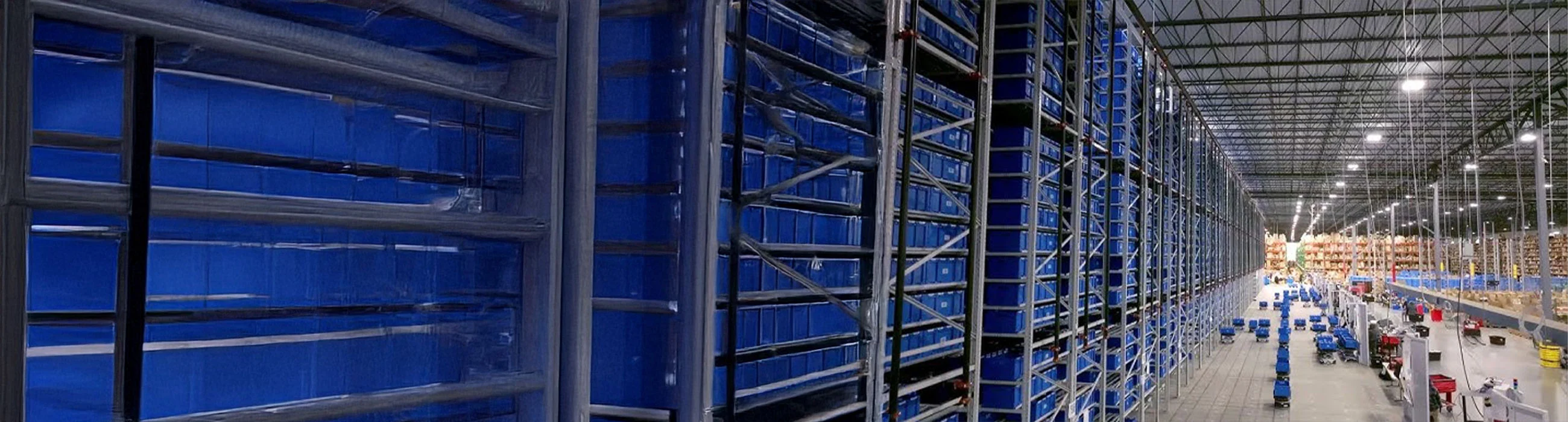
Vertical storage systems use available height to store more products within the same footprint. For businesses with dense inventory and limited space, they are often among the fastest-returning investments when compared with the cost of expanding floor area. Shuttle systems provide high-density storage using vehicles that move horizontally within aisles.
The warehouse management system is the decision layer above these physical components. It determines where products are placed, the order in which orders are picked and the routes to be followed. No matter how capable the automation hardware is, weak put-away and picking strategies prevent the expected efficiency from being achieved.
End-to-end automation and intralogistics integration
In turnkey intralogistics projects, site surveys, flow analysis, mechanical and electrical design, software, commissioning and after-sales support are addressed through one engineering approach. This gives logistics automation and warehouse automation a scalable structure using conveyors, sorter systems, automated storage solutions and AGV/AMR systems according to the requirement.
To maintain uninterrupted field operations, PLC, SCADA and HMI integration connects the control and monitoring layer, while WMS/WCS integration establishes reliable data flow between warehouse management and equipment orchestration. This integrated approach delivers industrial system integration that brings factory automation projects together with material movement.
Automation in warehouse, manufacturing and sorting processes
Intralogistics automation manages material movement throughout the facility, while warehouse automation, sorter systems, automated storage systems, AGV and AMR systems and conveyor systems operate within one coordinated flow. WMS and WCS integration supports task and inventory management, while PLC and SCADA integration supports field control and operational visibility.
In high-volume order and dispatch operations, e-commerce warehouse automation and parcel sorting systems direct products quickly and accurately to the correct destinations. On the shop floor, in-plant logistics automation organises line feeding and semi-finished-product transfers. When choosing among factory automation companies, businesses should evaluate engineering, integration, commissioning and after-sales support capabilities together.