





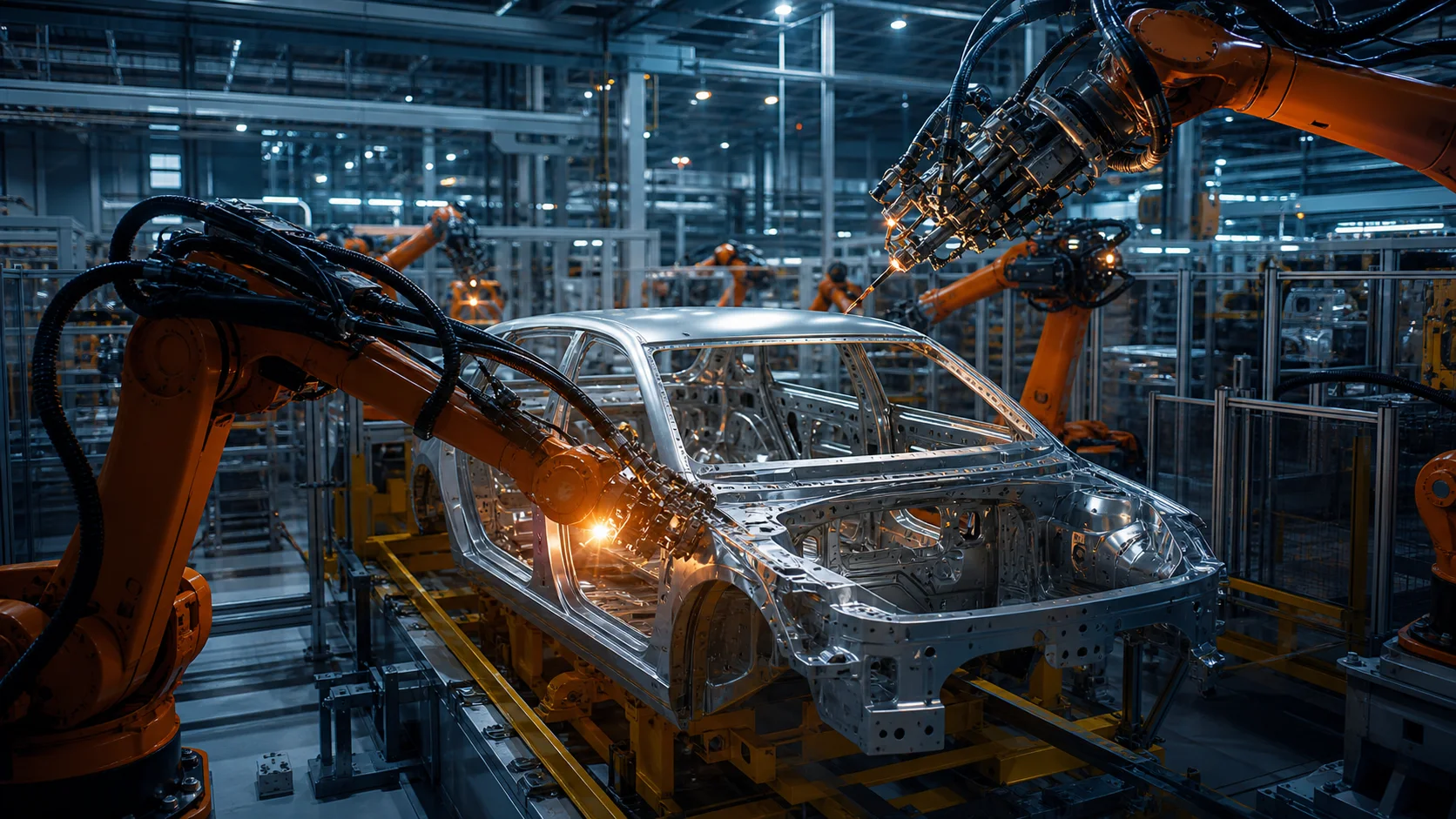
Integrated Automation and Safety Transformation on an Automotive Production Line
Fragmented control practices were unified through a standard PLC/HMI architecture, controlled operating modes and verifiable safety functions.
Company names, facility locations and identifying information have been removed. Performance values are presented as rounded ranges to protect customer confidentiality.
Integrated Automation and Safety Transformation on an Automotive Production Line
Stations followed different control conventions, while restart and fault recovery depended heavily on individual operator experience.
The objective was to create a sustainable operating model rather than automate an isolated task.
Operational consistency
Stations followed different control conventions, while restart and fault recovery depended heavily on individual operator experience.
Integrated architecture
We standardized operating modes, inter-station handshakes, alarm guidance and safety functions, then validated normal, fault and restart scenarios together.
Scenario-based acceptance
Normal operation, exceptions, recovery and critical safety scenarios were tested with operations teams.
Engineering approach
From requirement to system behavior
- Field requirements and operating constraints were modelled before implementation.
- Equipment, software and data interfaces were designed around a common operating context.
- Operator guidance, alarms and recovery scenarios were included in the design.
Controlled implementation
- We standardized operating modes, inter-station handshakes, alarm guidance and safety functions, then validated normal, fault and restart scenarios together.
- Changes were verified through traceable test and acceptance scenarios.
- Operations and maintenance teams participated in commissioning and handover.
Measurable operational outcome
The line became a manageable production system with repeatable behavior, clearer downtime context and verifiable machine safety.